
Topic – Affiliate/CPA Networks
Post Reading Time – 30 Minutes
If you’ve ever tried to earn money from a website, an app, or even a simple download page, you’ve probably run into the same problems that most people do. The traffic comes in, but turning it into income is difficult, inconsistent, or just disappointing. Somewhere along the way, the name Adsterra usually comes up as an option worth checking, especially if your website visitors are not all coming from the usual high paying countries.
This Adsterra Review looks at what the network offers, who it seems to suit best, and what you should be aware of before you use it. I’ve based it on the platform details and feedback from publishers, with the aim of helping you decide if Adsterra is a good option for your type of traffic.
Adsterra comes up so often because it works in a similar way to other ad networks that let you place ads on your website and earn money from views, clicks, or actions, but it is generally more open when it comes to traffic sources and visitor locations. This is usually why it gets mentioned when people start looking beyond the stricter ad platforms.
You can find more details on the official Adsterra website if you want to take a quick look for yourself.
Summarize This Content Using AI
TL;DR
Adsterra review
This review looks at the Adsterra advertising platform and what you can expect from it in everyday use. It covers all of the key features, how it works for publishers and advertisers, and some of the things to consider before using it on your own website. That gives you a better view of Adsterra so you know what it does and what to expect if you decide to try it yourself.
A Quick Summary Of Adsterra
Product name– Adsterra
Platform focus– Adsterra is an online ad network that allows website owners, app developers, and traffic owners to place ads on their properties and earn money from impressions, clicks, or actions.
Common use cases– It’s mainly used to monetise people’s websites, mobile sites, apps, and in some cases direct traffic links, especially where traffic comes from international or mixed audiences.
Ad formats– The network supports a wide range of ad types, including popunders, banners, native ads, in-page push style units, social bar formats, video ads, and direct link monetisation.
Traffic flexibility– Adsterra is often used by publishers whose traffic does not fully meet the requirements of stricter ad platforms, including traffic from non-tier or mixed GEO locations.
Scale and reach– The platform reports serving tens of billions of ad impressions each month across more than 200 countries, with thousands of advertisers and publishers active at any time.
Who it’s aimed at– Adsterra tends to be good for publishers who are comfortable testing different ad formats, working with global traffic, and actively managing how ads appear on their sites.

How Big Is Adsterra’s Reach as an Ad Network
Adsterra isn’t a small or regional ad network. Based on the figures that the platform shares, it operates on quite a large scale, with ads running across a wide range of countries and traffic types. The network reports serving tens of billions of ad impressions each month, with campaigns active in more than 200 countries.
That broad coverage is one of the main reasons Adsterra often comes up when publishers talk about monetising traffic that isn’t limited to the top-paying regions.
Advertisers are active across many locations, so traffic from outside the usual markets isn’t automatically ignored. This can make a difference for websites that receive visitors from places like India, Brazil, Vietnam, or other mixed regions.
There are also thousands of advertisers and publishers active on the platform at any given time. In practical terms, this helps keep the ads running consistently and reduces the chances of pages sitting without anything to show, even when the traffic sources vary.
What Kinds of Publishers Use Adsterra Ads
This is one area where I think Adsterra is flexible. It’s used across a wide range of setups, from traditional websites to projects that don’t rely on a full website at all. You’ll often see it on standard desktop and mobile websites, as well as on mobile-focused projects such as apps, downloads, or utility-style platforms.
It’s also used for direct link monetisation, where traffic is sent straight to an offer, landing page, or download without placing visible ads on a site. That makes it a good choice for publishers who work with short links, landing pages, or other lightweight setups.
Adsterra also seems to be open to international and mixed audiences.
If your visitors come from a range of locations rather than one single market, ads are still likely to appear, although the rates and volume can vary depending on where that traffic comes from.
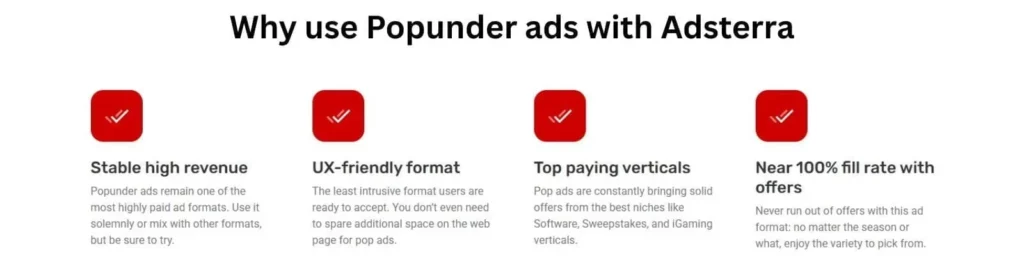
Screenshot from Adsterra showing how the platform presents popunder ads
Which Ad Formats Are Available on Adsterra
I think that this is one area where Adsterra stands out. It doesn’t restrict you to basic display banners, which is where many other ad networks stop. Instead, it offers a good mix of ad formats, some of which are more aggressive and some that are easier to blend into a page, depending on what kind of audience you’re dealing with.
Popunder Ads
Popunder ads are one of the most commonly used formats on the platform.
These open behind the main browser window and are often used with international or mixed traffic. They can generate higher returns, but they also need to be handled carefully, as overusing them can frustrate website visitors.
In-Page Push Ads
In page push ads are designed to look similar to push notifications, but they load directly within the page itself. Because of that, they tend to feel less intrusive and can be positioned more flexibly.
Social Bar Formats
Social bar ads use a different approach by appearing as floating widgets that can resemble chat boxes, alerts, or small notifications and can be used for surveys or promotional offers.
Native Ads
Native ads are designed to sit alongside your content and follow the same visual style, which can make them easier for visitors to accept. That said, they don’t always produce the same level of return as more aggressive formats.
Display Banner Ads
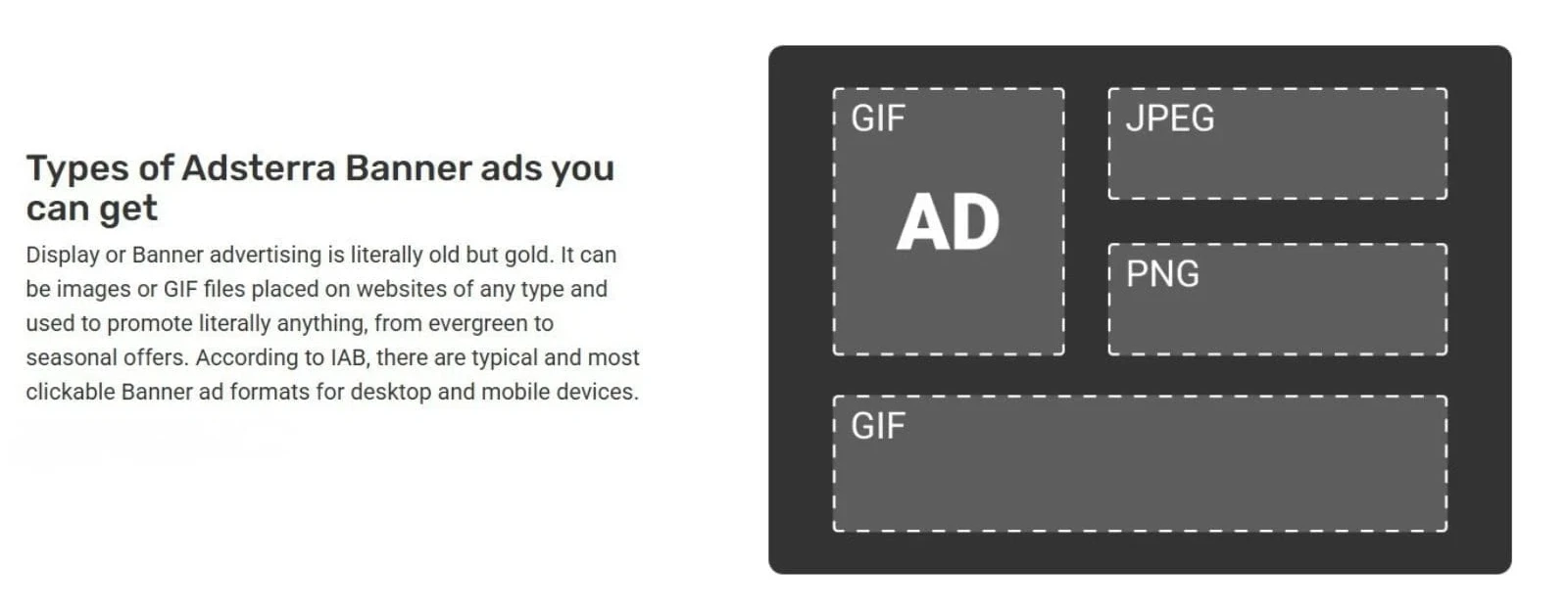
Display banner ads are also available in the usual sizes and placements and are often used when a cleaner layout is preferred.
Video Pre-Roll Ads
If you run video content, there’s also support for video pre-roll ads that play before a video starts.
Direct Link Monetisation
For publishers who don’t rely on visible ads at all, direct link formats will allow traffic to be sent straight to an offer, landing page, or a download instead.
One advantage of having all these options is the flexibility. If one format causes problems or doesn’t perform as expected, it’s usually possible to switch to another. Sites whose visitors are already familiar with pop-style or direct promotions often see a higher fill and stronger returns, while others may prefer to stick with lighter formats.
How Adsterra Pays Publishers
All the ad formats in the world don’t mean a thing if the payment side isn’t clear.
I’ve read that Adsterra supports several payment models, and which ones apply will depend on the ad formats you use and the type of traffic you send.
You can also look through Adsterra’s official publisher page to see how the platform explains its ad formats, payouts, and approval process.
CPM payments
CPM (Cost Per Thousand Impressions) is based on impressions, which means you earn money when ads are shown to visitors, even if they don’t click them. Rates can vary a lot depending on where your traffic comes from, the ad format being used, and current advertiser demand. Some impressions may pay very little, while others can bring in higher returns.
CPC payments
With CPC (Cost Per Click), you earn when a visitor actually clicks on an ad. This model is more common with banner-style placements and is less often used with formats like popunders.
The earnings here will depend heavily on how visitors interact with the ads rather than just how many people see them.
CPA, CPI, and CPL payments
These payment models are based on actions rather than just views or clicks.
CPA stands for Cost Per Action. You earn money when a visitor completes a specific action set by the advertiser, such as signing up, completing a form, or confirming their details.
CPI means Cost Per Install. This applies mainly to mobile traffic and apps. You get paid when a visitor installs an app after clicking on an ad.
CPL stands for Cost Per Lead. With this model, you earn when a visitor becomes a lead, usually by entering their email address or other contact details.
These types of offers pay more for each completed action, but just remember that fewer visitors will follow through compared to simple views or clicks, since they require extra effort from the user.
RTB pricing
RTB, or real-time bidding, allows advertisers to compete for traffic.
When there’s strong demand, this can push rates higher, especially for certain locations or traffic types. Results can vary, and returns may change depending on how competitive the bidding is at any given time.
Overall, earnings depend on a mix of impressions, clicks, and completed actions. It’s also possible to run more than one ad format at the same time. If one format isn’t producing results, other formats can be used instead, giving publishers more control over how their traffic is monetised.
What Types of Ads Are Common on Adsterra?
A lot of the advertising on Adsterra is around direct response offers. These are ads that encourage visitors to take action quickly, such as downloading something, signing up, or making a purchase.
You’ll often see ads related to things like online privacy and security tools, including VPNs and other similar services. Downloadable software and utility-style tools are also quite common, along with subscription-based offers where users are asked to sign up for ongoing services.
Sweepstakes and giveaway-style promotions appear regularly too, usually by using simple entry forms or prize draws. Online gaming, betting, and casino-related ads are another frequent thing you’ll see, as are dating and adult-oriented offers, depending on the traffic and the filters used.
E-commerce ads also show up a lot, mostly in the form of discount offers, coupons, or banner-style promotions. In some cases, crypto-related tools or wallet services are promoted as well, although these require a bit more caution due to the changing rules and advertiser requirements.
If your visitors are interested in online services or offers that encourage quick interaction, there’s usually plenty available to show.
For sites that rely on a cleaner image or a more family-friendly setup, it’s important to use the available controls and filters carefully to avoid showing ads that don’t sit well with the tone of the site.
How You Control the Ads That Appear on Your Site
This is one of the areas publishers usually care about the most. Nobody wants low-quality ads, unexpected redirects, or content that doesn’t sit well on their website.
Adsterra gives publishers a reasonable level of control over what appears and how often it shows.
Choosing which ad formats run
You’re able to decide which ad formats you want to use and which ones you’d rather stay away from. This makes it easier to stick with the lighter options like banners or native ads, or test more aggressive formats if your audience is used to them.
Controlling placements and layout
Ad codes can be placed where they make sense for your website, whether that’s banners in fixed positions, pop-style formats, or social-style units. This helps you to keep some control over how the ads fit into your pages rather than letting them appear randomly.
Limiting how often ads appear
Frequency settings allow you to limit how often ads are shown to the same visitor. This can help to prevent people from feeling bombarded, especially when using formats that demand more attention.
Targeting by location and device
Adsterra allows filtering based on the visitor’s location, as well as separating mobile and desktop traffic. This helps to make sure that the ads are more relevant to the people seeing them and reduces the chance of unsuitable offers appearing.
Blocking specific offers or sources
If certain ads, domains, or types of offers aren’t appropriate for your site, they can be blocked directly from the dashboard. Whitelisting can also be used to focus on the ads that perform better or suit your content more closely.
Adjusting bids and testing traffic
There are tools that allow bid adjustments and traffic estimation before launching the campaigns. These can give you a rough idea of how traffic might perform and help prioritise higher-value placements.
Reporting and advanced access
Performance data is available through a simple reporting dashboard that shows earnings and traffic activity in almost real-time. For more advanced setups, API access is also available for automating reports or managing campaigns externally.
Even if you leave most control settings alone, it’s still a good idea to occasionally check what ads are being shown.
Getting Started with Adsterra in This Review
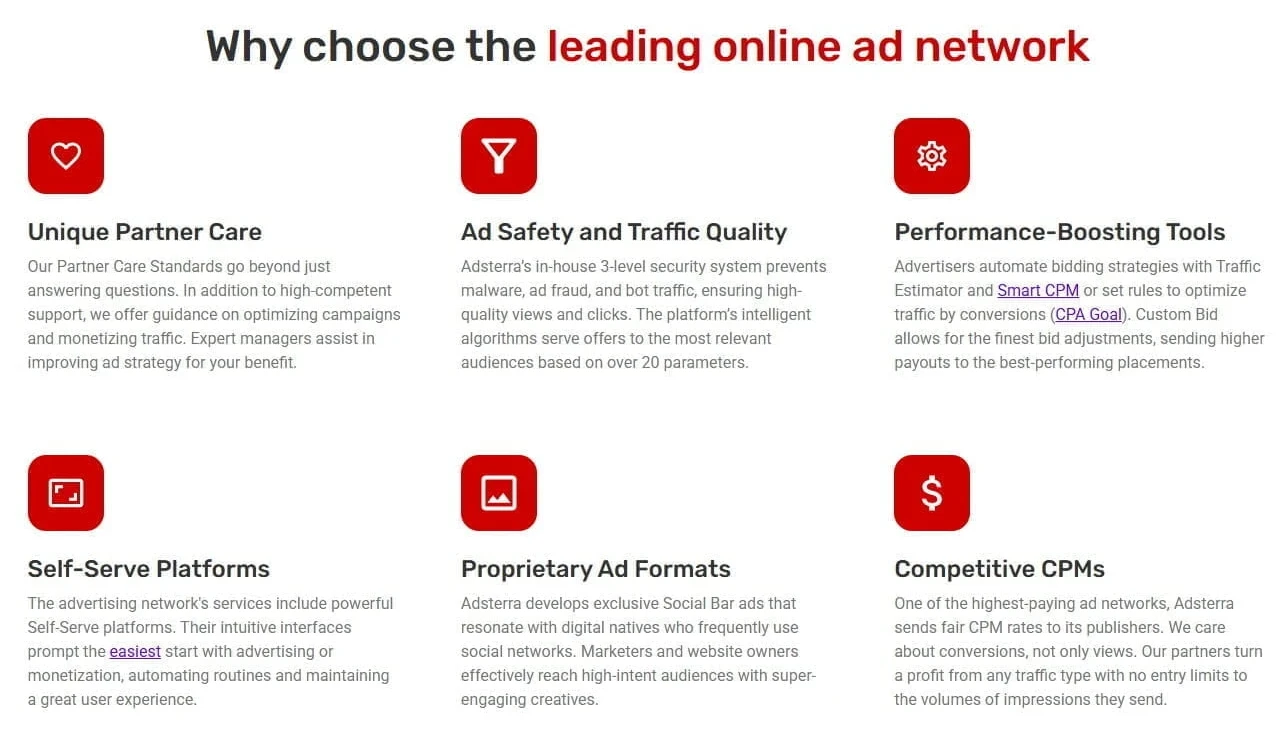
Getting started with Adsterra is pretty straightforward, which helps explain why it attracts publishers and advertisers from so many different countries.
The sign-up process is simple and it doesn’t take too long to get through.
You begin by registering either as a publisher or an advertiser. After that, you add your website, app, or other property for a review. In some cases approval can happen quickly, and sometimes it can take a little longer if the site needs a closer look.
Once approved, publishers can create ad units by choosing the formats they want to use and placing the generated code on their website or app.
Advertisers need to fund their account before campaigns can run, while publishers start earning once the ads are live and traffic begins to flow. From there, the basic controls can be set, such as choosing ad types, filtering by country, and adjusting how the ads will appear.
Everything can be managed without outside help, but there is also the option to contact a dedicated account manager if traffic volume justifies it. The dashboard itself is easy to move around, and the reporting is clear enough that even first-time users shouldn’t struggle to understand what’s going on.
Adsterra for Advertisers
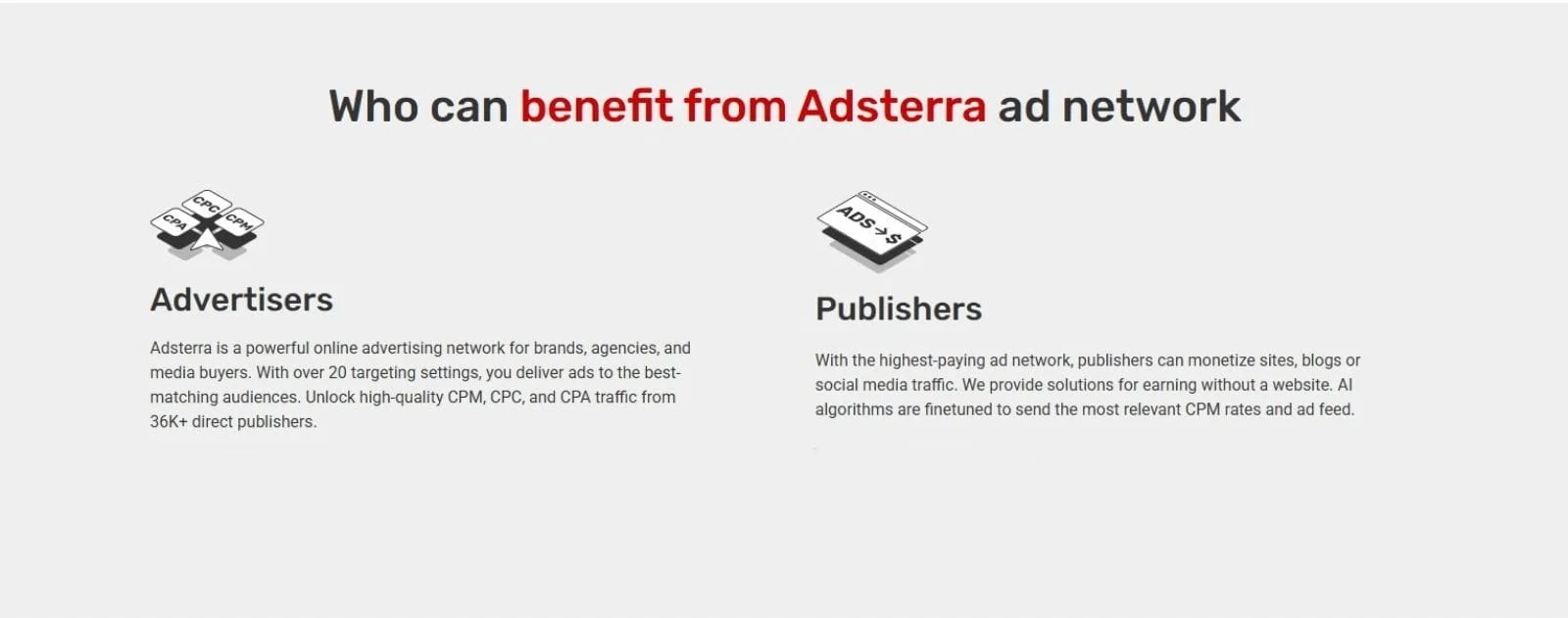
Although this review mainly looks at Adsterra from a publisher’s point of view, the platform is also widely used by advertisers who want to buy traffic directly.
Advertisers typically start by funding their account and creating campaigns through the self-serve dashboard, with options to choose the ad formats, locations, devices, and other targeting settings.
A minimum deposit is usually required before campaigns can run, which helps to make sure that advertisers are serious about testing their traffic.
Adsterra is often used for direct response campaigns, where the results depend heavily on tracking and testing rather than setting things up once and leaving them alone. Advertisers who take the time to monitor performance, adjust the bids, and refine targeting get more consistent results than those who just sit there expecting instant returns.
Support is available for advertisers as well, including access to account managers for higher-volume campaigns. This can be useful when testing new traffic sources or formats, especially for those who are new to buying traffic.
As with most ad platforms, Adsterra works best for advertisers who are prepared to test things carefully, start with controlled budgets, and build up once they understand what performs well.
Tracking and Testing Ads on Adsterra
Adsterra isn’t something you just set up and then leave it to run without paying attention to what’s happening. If you want to know what’s actually generating earnings, you need to keep your eye on a few basic things.
Some ads pay just for being shown, but other ads only pay when a visitor does something, like signing up or installing an app. When that’s the case, Adsterra needs a way to confirm that the action really happened.
This is done by adding a simple tracking link or code, which lets you see which ads are actually producing the results instead of just showing impressions.
Over time, you’ll notice that not every ad placement performs the same.
An ad that works really well on one page might do very little on another. Looking at these stats will help you to see where the clicks, actions, or earnings are coming from, so you’re not guessing.
Earnings can also change from week to week. Sometimes advertisers pay more, sometimes less. That’s normal with ad networks and doesn’t always mean something is wrong. What matters is seeing these patterns rather than reacting to a single good or bad day.
You don’t need to be making changes all the time, but checking your stats occasionally helps you see what’s actually happening and which ads are worth keeping.
How Adsterra Handles Payments
This is usually the part people care about most, and it’s also where many ad networks cause confusion or frustration. Based on how Adsterra works and how publishers describe their experience, the payment side is pretty clear.
Payment methods available
- WebMoney and Paxum
- PayPal
- Bitcoin and Tether
- Bank wire transfers
The available options can vary depending on where you’re based and how you choose to get paid.
Minimum payout levels
- Digital wallets and crypto options can start from lower thresholds, often between $5 and $50
- Bank wire payments usually require a higher balance, commonly $100 or more
Payment schedule
- Payments are typically sent every two weeks
- Accounts need to be in good standing, and with the correct payment details set up
Adsterra payout minimums and fees can change
The minimum payout amounts and any related fees on Adsterra aren’t fixed. They can vary depending on the payment method you choose, the country you’re based in, and sometimes how your account is set up.
Digital wallets and crypto options usually have lower thresholds, while bank transfers often require higher balances and may include extra fees.
Because these details can change over time, it’s best to check the current payout limits and payment terms on Adsterra’s official website before requesting a withdrawal.
Reliability
- Most of the publisher feedback which I’ve seen points to payments arriving as expected
- Delays tend to be linked to banking holidays or incorrect payout information rather than missed payments
Lower payout thresholds on wallets and crypto make it easier for smaller sites to withdraw their earnings without waiting too long, which is good if you’re testing things or working with modest traffic levels.
Publisher Requirements and Platform Rules
Adsterra is open when it comes to the types of sites and projects it accepts, but there are still some clear rules that need to be followed.
The traffic has to be genuine. Artificial activity such as bots, proxy traffic, or incentivized visits is not allowed and it can lead to an account being closed along with any unpaid earnings.
Traffic exchanges and autosurf systems are also flagged very quickly.
If the platform detects this kind of activity, accounts can be restricted or removed and decisions are usually final. The same applies to content. Sites must comply with the legal requirements, and many ad formats are only available on websites that stay away from illegal or adult material.
Adsterra does enforce its rules, and breaches of these rules can result in accounts being shut down.
Some ad formats also have minimum traffic or impression levels in place to maintain quality, so not every option will be available to every publisher from day one.
In general, the focus is on genuine visitor activity rather than big numbers. A smaller number of real visitors who interact naturally is far more important than large volumes of low-quality traffic.
As with most of the ad networks, keeping traffic sources clean and transparent will help to avoid problems later on.
Adsterra and Website Safety
One of the biggest concerns people have with ad networks like Adsterra is how the ads might affect their website and their visitors.
Adsterra does put systems in place to reduce unsafe ads, forced redirects, and malicious behaviour, but it’s important to know that no ad network filters everything perfectly. This is especially true when using the more aggressive formats like popunders or direct links.
Publishers have a good level of control over what appears on their website. You can block specific categories, offers, or domains, limit how often ads are shown, and choose lighter formats if your site relies on a cleaner layout or long-term trust.
Many publishers begin with banner or native-style placements and only test stronger formats once they understand how their audience reacts. Keeping the frequency limits low and checking the ads manually from time to time helps avoid any surprises.
If your website depends heavily on search visibility, branding, or user trust, Adsterra can still be used, but it needs to be managed rather than left to run on its own. Used with sensible settings and regular checks, it can be kept under control. Used carelessly, it can cause problems.
Anti-Fraud and Security on Adsterra
Adsterra has a lot of emphasis on security, and this is mainly to protect advertisers and keep traffic quality under control.
The platform uses automated systems to monitor the incoming and outgoing traffic and look for patterns that suggest bots, proxies, or other artificial activity. Ads and landing pages are also checked to reduce the risk of malware, forced redirects, or other behaviour that could cause problems for publishers.
New websites and campaigns are reviewed before going live. Some of this screening is automated and some of it involves manual checks, depending on the situation.
Traffic is also monitored on an ongoing basis, which means unusual activity can be flagged after a website is already running.
That said, no ad network filters everything perfectly.
Lower-quality ads can still appear from time to time, especially when using formats like pop-style ads or direct links. Because of that, it’s a good idea to occasionally look at what’s being shown and block or report anything that doesn’t feel right for your site.
What to Expect from Adsterra Support?
Support is handled through a few different channels, depending on the type of help that’s needed.
Any basic questions can usually be dealt with through the live chat inside the dashboard, while more detailed issues are handled through an email or a ticket system. For publishers or advertisers working with higher volumes, there’s also the option of having a dedicated account manager.
Support is available in more than one language, which helps given how international the platform is. From what publishers generally report, responses are usually reliable, although reply times can slow down during busy periods or at weekends.
Larger accounts often receive faster attention, while the smaller publishers may need to wait a little longer for a response.
Overall, the support setup covers the essentials. It’s not perfect, but it’s generally reliable.
What People Tend to Like About Adsterra
From the feedback that keeps coming up, there are a few positives that publishers mention quite regularly.
- It has a wide range of ad formats, which gives more room to test different setups instead of being limited to one style
- Popunder ads can bring stronger returns for certain types of traffic, especially when other networks are more restrictive
- Advertisers are active across many regions, so traffic from outside the usual markets is still monetised
- There are multiple ways to earn, with different formats and payout options depending on how you run your website
- Payments are generally reported as arriving on time, with no widespread complaints about missed payouts
Things to Be Aware Of Before Using It
I’ve also read about some downsides that are worth keeping in mind before committing to it.
- Some of the ad formats are intrusive and can affect how visitors interact with a website
- Earnings can vary a lot depending on the traffic type, ad format, and advertiser demand
- The CPM rates change regularly, so income may rise and fall from week to week
- The reporting dashboard covers the basics, but a deeper analysis often requires outside tools
- Lower-quality ads can appear at times, especially with pop-style formats or direct links
- Sites that rely heavily on a clean layout or strong SEO need to be cautious with aggressive ad types
Like with most ad networks, Adsterra has its ups and downs. How well it works really comes down to the type of website you run and how much control you want over the ads that appear.
When Adsterra Can Be a Reasonable Option?
Adsterra seems to be a good choice for publishers who are comfortable experimenting with how they monetise their traffic. It works best on side projects, secondary sites, or traffic sources that don’t always meet the entry requirements of the stricter ad networks out there.
It’s often used on download pages, streaming sites, or other projects where the traffic behaviour can vary from page to page. In those situations, the more aggressive ad formats can sometimes generate revenue that other platforms simply won’t offer.
On the other hand, it may not be a good choice for brand-focused websites or projects where long-term trust and search visibility are the top priorities. Some ad formats can be disruptive, and if they’re not handled carefully, they can affect how visitors interact with a website.
Adsterra also isn’t something that works that well on autopilot. It rewards publishers who are willing to keep an eye on the performance, review what’s being shown, and make any changes when they’re needed.
For those people who like staying involved in how their sites earn, that flexibility can be a good positive rather than a drawback.
Things Worth Knowing Before Using Adsterra in This Review
There are a few details that can surprise people if they’re not expecting them.
One is that not all ad formats are available at the same time or under the same conditions. Some formats, like banners or native ads, are easier to access, while others may require higher traffic levels before they become available to you.
Payment thresholds also depend on how you choose to get paid.
Wallets and crypto options usually allow withdrawals at lower balances, while bank wire payments typically require a higher amount before anything can be sent. This doesn’t cause problems as such, but it’s worth knowing about upfront.
The platform itself is pretty easy to understand, but earnings don’t usually come from setting things up once and forgetting about them. Results seem to improve when the ads are reviewed, placements are adjusted, and performance is checked on from time to time.
On the security side, most of the low-quality ads are filtered out automatically, but no system is perfect. From time to time, ads may appear that aren’t great, which is why checking what’s being shown and blocking anything unsuitable is still important.
It’s also worth being cautious with income screenshots shared online.
High earnings do happen, but they usually reflect large partners with strong traffic sources. For most publishers, results are more modest and they depend heavily on the type of website and traffic being used.

Frequently Asked Questions – FAQs
Yes, Adsterra does pay publishers, and this is one of the areas where the platform generally gets positive feedback. Payments are made once the minimum payout is reached and the account is in good standing.
Most reports of missed or delayed payments tend to be linked to incorrect payout details or banking holidays rather than Adsterra withholding funds. As with any ad network, keeping your traffic clean and following the rules is important to avoid any issues.
Earnings with Adsterra vary a lot, and they depend on several factors, including the type of traffic, where visitors come from, which ad formats are used, and how actively the ads are managed.
Some publishers earn modest amounts from smaller sites, while others with large volumes of traffic can earn significantly more. There’s no fixed income level, and results are rarely consistent from site to site.
Anyone promising exact daily or monthly figures is usually oversimplifying how ad networks work.
Adsterra can be suitable for beginners, especially for those who have struggled to get approved by the stricter ad platforms. The setup process is relatively easy, and the dashboard doesn’t take long to understand.
That said, beginners still need to pay attention to what ads are showing and how they affect their site. While it’s accessible, it works better when users are willing to keep an eye on performance instead of just expecting it to run perfectly on its own.
The main difference is how strict each platform is.
Google AdSense has tighter rules around content, traffic sources, and ad presentation. Adsterra is more flexible in comparison and supports a wider range of ad formats, including pop-style and direct link ads.
This flexibility makes it appealing to those publishers whose traffic or website type doesn’t fit AdSense guidelines.
Adsterra works best on sites where traffic comes from a variety of locations or where visitors are already accustomed to promotional content. It’s often used on side projects, secondary sites, or platforms where stricter networks aren’t an option.
Websites that rely heavily on brand image, long-term trust, or search visibility need to be more selective with formats and settings. The platform rewards publishers who understand their audience and are willing to manage how ads are displayed.
How This Adsterra Review Was Put Together and Tested
This review is based on a close look at how Adsterra works, how it’s positioned, and how publishers describe their experience using it. I’ve reviewed the platform documentation, common publisher feedback, and how Adsterra is typically used across different types of websites.
While I haven’t run Adsterra ads on Affiliate Pro Solutions, I do have experience working with websites where advertising is used as a monetisation method. On this site, I’ve chosen not to display ads, mainly to keep the content focused and free from distractions for my readers.
That choice doesn’t make ad networks irrelevant. Many site owners reach a point where ads become a practical option, especially when their traffic doesn’t suit the stricter platforms.
The goal of this review is to explain how Adsterra operates, where it’s commonly used, and what to expect if you decide to test it on your own website, without inflated claims or unrealistic promises.
Other Ad Networks Worth Looking At
Adsterra isn’t the only option people consider, and it usually comes up after publishers realise that more restrictive platforms aren’t good for their traffic or the types of ads they want to run.
For some, that moment happens after running into limits with Google AdSense. From there, a few other networks seem to appear in the same conversations.
- PropellerAds
Often mentioned for its pop-style and push-based ads, with broad international coverage. It’s commonly used on websites with mixed traffic sources. - PopAds
Focuses mainly on popunder advertising and is known for having lower traffic requirements than many of the other platforms. - MGID and Outbrain
These are more centred around native ads. They usually have stricter entry requirements, but the ad style tends to be less disruptive. - Evadav
Specialises in push notification traffic and overlaps with Adsterra in some offer types, particularly around direct response campaigns.
The network that makes the most sense for you will often depend on the type of website you run, where your traffic comes from, and how much control you want over the ads that appear.
Final Thoughts in This Adsterra Review
Adsterra can be a good choice if you’re looking to earn from traffic that doesn’t always work well with the more restrictive ad platforms. It’s used when visitors come from a wide range of locations or when a website doesn’t fit neatly into those tighter rules.
The platform itself is pretty straightforward, and the payment setup is easy to understand, but it’s not something that works if left completely alone. The results will be better when you pay attention to which ads are showing and how they affect your pages.
Some formats are more aggressive than others, so keeping an eye on how visitors respond is important, especially if your website relies on trust or search visibility.
Adsterra works at its best when it’s treated as a practical tool rather than a guaranteed income source. If you use it carefully, it can help turn traffic into earnings where other options struggle, but the outcome will always depend on the type of site you run and how involved you want to be in managing the ads.
If you’ve made it this far, thanks for taking the time to read through the review. I hope it’s helped you understand more about Adsterra, and whether it’s something worth testing for your own site.
If you’ve already used Adsterra, I’d be interested to hear how it worked out for you. And if you’ve got any questions, feel free to leave a comment below.
Chris
If you want to take a closer look, you can visit the official Adsterra website directly and go through the details yourself. Just go in with clear expectations and a good idea of how you’d want ads to appear on your site.
Quick Summary
Adsterra can be a good choice if you’re working with international or mixed traffic and need an ad network that’s more flexible than the stricter platforms. It offers a wide range of ad formats and works at its best when you’re willing to keep an eye on what’s being shown and make any changes when they’re needed.
It’s not that suitable for brand-focused websites or projects where a clean layout and long-term trust are the main priority, especially if more aggressive ad formats aren’t a good thing for your audience.
My Overall Rating For Adsterra Is 3.5 out of 5
Wealthy Affiliate
This is where my journey into the online world began, and it’s still the community I use for learning, tools, and support while working on my own projects.

About Chris Towers – Follow Me

My name is Chris Towers, and I run Affiliate Pro Solutions. I work with websites, content, and affiliate projects, and this website is where I share what I’ve learned from doing that work.
Most of what I write about comes from researching hosting companies, tools, and platforms that people use when building websites or trying to earn online. I look at how things are set up, what’s included, and where people often get caught out later.
I’m not connected to the companies I review beyond standard affiliate partnerships. This site does include affiliate links, but the aim here is to explain how the services work rather than push anyone into a decision.
You’ll find me on
Just to be open with you, this page includes affiliate links. If you click on one of these links and make a purchase, I earn a small commission. There is no extra cost to you at all. This simply helps support the content I share here. Thank you for your support, it really is appreciated.
I’ve been looking at Adsterra as an alternative to AdSense, mainly because my traffic doesn’t always sit with the usual rules.
What I like is that it seems more open when it comes to traffic sources and ad formats. At the same time, it’s clear you can’t just set it up and forget about it. You need to keep an eye on what’s running and how it affects your site.
For me, that’s not a bad thing. I’d rather have some control and know what’s going on than rely on something that feels too strict.
It looks like it could be a decent option for sites with mixed or international traffic.
Thanks for sharing that.
I agree, Adsterra can be useful when AdSense just isn’t an option, but it does need a bit of attention. It’s not something I’d ever leave running without checking what’s showing.
If you’re happy keeping an eye on it and making changes as you go, it can be good for the right kind of website.
Hi Chris and thanks for the review. It was easy to read and it helped me understand Adsterra better. I picked up a few things I didn’t know before.
I liked that you didn’t try to oversell it too and you pointed out where it can be good and where is maybe isn’t the right option for a website.
Thanks
Leah
Thanks Leah, much appreciated.
I’m glad it helped you out and that you found it easy to read. That was exactly what I wanted with this one, just being honest without overselling it.
Thanks for taking the time to comment.