

Topic – Business Management
Post Reading Time – 11 Minutes
Do you always seem to be struggling to get things done no matter how hard you work? Most people waste so much time on tasks that barely make any difference and only a small fraction of their efforts actually bring in results.
So, what is the 80 20 rule about? It’s a simple principle that explains why 80% of your outcomes often come from just 20% of your actions. Understanding this can change how you work, increase your productivity levels, and even improve your daily life.
In this post, I’ll talk to you about how the 80-20 rule works, why it matters, and how you can use it to stop wasting a lot of your time and start seeing some results.
The Pareto Principle – The 80-20 Rule
The 80-20 Rule, or Pareto Principle, shows that 80% of your results usually come from just 20% of your efforts. Instead of spending time on things that don’t really matter, the focus is on what actually brings in the results.
The less important stuff still exists, but it shouldn’t take up most of your time. This applies to business and everyday life.
What You’ll Learn From This Post
- What The 80-20 Rule Is – How a small part of what you do brings in most of your results, and why understanding this can help you stop wasting time on things that don’t matter.
- How To Focus On What Works – Learn to spot the 20% of tasks that actually make a difference, so you don’t waste time on things that get you nowhere.
- How Businesses Use The 80-20 Rule – See how companies apply this rule to save time, improve profits, and focus on the customers who matter most.
- How It Helps In Everyday Life – Whether it’s your schedule, your home, or your habits, this rule can help you make better use of your time and concentrate on what matters.
- How To Get The Balance Right – Focusing on the most important things doesn’t mean ignoring everything else. Learn how to manage the smaller tasks without letting them take over.
Summarize This Content Using AI

Start Your Training
- Build Your Website & Earn Revenue
- Support, Tools & Training Included
- Complete with Business HUB
- Artificial Intelligence Writers
- My Personal Support
- No Risk Free Starter Account
- FREE BONUS AI CREDITS
TL;DR
What the 80 20 rule is about
The 80 20 rule explains that a small portion of your actions often produces most of your results. This post talks about how the idea works and how you can tell which parts of your day or work that have the biggest impact. Knowing this helps you put your effort into where it matters the most.
So, as we have already said, 80% of what you achieve might come from just 20% of your efforts.
A lot of people try to look at this as a formula, and while some will say it is not set out in stone, other people see it as just a simple truth. Most of what really gets results comes from a small part of what you do.
So why spend hours working on things that don’t make much of a difference?
Try to look at your own daily routine as an example. Which tasks actually move things forward, and which ones just eat up a lot of your time?
The 80-20 Rule is a way to concentrate on what brings in the biggest results. What matters is putting your time into the things that actually get results. By concentrating on the 20% that counts, you can get more done without wasting time on things that don’t matter.
Are you ready to figure out what actually makes a difference?

The Origins of the Pareto Principle
The Pareto Principle, or 80-20 Rule, comes from an observation which was made by Italian economist Vilfredo Pareto back in the 19th century.
It all started in his garden. Pareto noticed that most of his pea pods came from just a few plants. This made him wonder if the same kind of imbalance also existed elsewhere.
When he looked at wealth distribution in Italy, he saw a similar pattern. This pattern showed him that 20% of the population owned about 80% of the land.
This went on to lead him to an even bigger realization. In many situations, a small number of factors create most of the results.
It’s fascinating how a simple garden experiment turned into a principle that applies to so many areas, such as business, productivity, and even daily life.
When you know which efforts bring the biggest results, you can concentrate on what really counts instead of wasting your time on things that don’t.
The Concept of the 80-20 Rule
The idea behind the 80-20 Rule is simple but makes a big difference.
Most of your results usually come from just a small part of what you do.
OK, this isn’t a formula as such, but it’s a pattern that shows up everywhere – business, economics, and everyday life. A small number of actions tend to create most of the results.
It won’t always be an exact 80/20 split, but you’ll find most of the time that a few important efforts bring in the biggest outcomes.
Think about your own work or daily routine again for a moment. Which tasks actually lead to good progress, and which ones just take up time?
By knowing what really moves things forward, you can put your energy where it actually counts the most.
The 80-20 Rule helps you put your effort where it actually matters.
Maybe it’s time for you to take a closer look at where your efforts are really going.
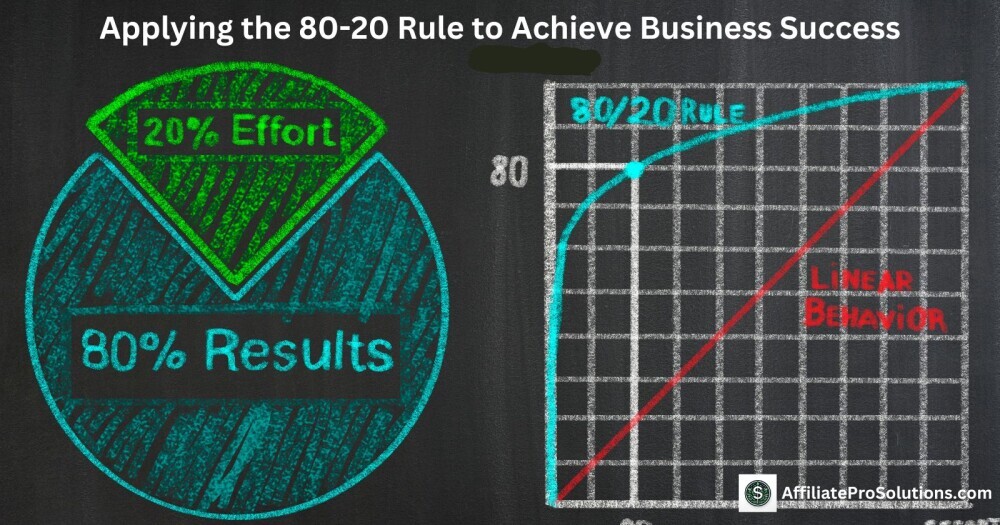
Applying the 80-20 Rule to Achieve Business Success
Running a business means making the right choices, and the 80-20 Rule can help with that. By concentrating on the 20% of efforts that bring in 80% of the results, businesses can work more efficiently and increase their profits.
Take a look at sales teams, as an example. It’s usually a small percentage of the team that closes most of the deals. So, instead of spreading resources thin, it makes more sense to invest in the top performers.
They do this by giving them the right tools and training to improve their success rates. This can make a big difference in their overall revenue.
Customer relationships work the same way. A small group of clients often brings in most of a company’s income. By focusing on these customers and offering better service or exclusive deals, businesses can build stronger relationships and increase their long term value.
The same idea applies to problem solving. In software development, fixing a handful of major bugs can solve most user issues and improve the experience for everyone.
When businesses recognize where the 80-20 Rule applies, they can fine tune their efforts and get better results without wasting time on things that don’t matter.
Which parts of your business could benefit from this?

The 80-20 Rule in Your Everyday Life
The 80-20 Rule can apply to your everyday life as well.
For example, take a look at your wardrobe. How often do you actually wear every piece of clothing you own?
If you’re anything like me, you probably stick to a handful of favorites while the rest just take up space. Being able to recognize this can make choosing what to wear easier, and it might even save you money by buying more of what you actually use instead of what you don’t.
Now think about your home. You probably spend most of your time in just a few rooms. So, instead of worrying about organizing every corner in the house, it makes more sense to concentrate on the spaces you use the most.
What about your phone? Have you ever checked to see how many apps you actually use?
Most of us only tap on a few while the rest sit there, untouched. I know I have apps I’ve never even opened. Getting rid of the ones you don’t need can free up space and make your phone run better.
Additional Business Management Info & Resources
Even relationships work this way.
A small group of close friends and family make up most of your interactions. Putting more time into these connections can improve your social life and strengthen relationships that actually matter.
The 80-20 Rule helps you focus on what counts.
Which areas of your life could benefit from this?
Using the 80-20 Rule for Maximum Productivity
The people who achieve the most in business, sports, or any other field understand that success isn’t about doing as much as possible. They’re concentrating on what brings the biggest results.
They don’t spread themselves thin trying to do everything. Instead, they put their energy into the 20% of tasks that actually move things forward.
If you want to be more productive, goal setting plays a big role in this. Having clear goals helps you figure out which tasks are worth your time and which ones aren’t. Instead of just staying busy, you work with a purpose.
Think about your own routine. How much time do you spend on things that don’t really make any difference?
The important thing is figuring out which tasks actually matter and putting your effort into them.
This is also where delegation can help you. When you focus on the work that counts, you free up time to either pass off or drop what isn’t worth it.
So how do you apply this?
Look at what you do every day. Cut out the tasks that don’t lead to results and put more effort into what does.
Making this change can help you get more done without feeling overloaded all the time.

Using the 80-20 Rule to Optimize Time Management
Time always seems to run out so fast, no matter how much we try to manage it. That’s where the 80-20 Rule comes in.
Start by figuring out the 20% of tasks that actually make a difference in your daily routine. The point isn’t to take shortcuts. It’s to use your time where it actually counts.
For example.
- Executives might get better results by concentrating on projects that actually push the company forward.
- Freelancers can get more done by prioritizing high paying clients instead of juggling low value work.
- Entrepreneurs can avoid distractions by sticking to a clear plan instead of jumping from one thing to another.
Once you know what’s worth your time, look at what you can delegate or drop completely.
Some tasks can be handed off to someone else, and some don’t need to be perfect. Sometimes, good enough is all you need.
That doesn’t mean ignoring everything else. The goal is to focus on what actually moves things forward while keeping everything else under control.
Where could you put more focus to make better use of your time?
Integrating the 80-20 Rule into Your Life
To make the 80-20 Rule work for you, you need to try and fit it into your everyday life. It’s a way of thinking that helps you concentrate on what really matters.
Start by looking at all the tasks and commitments on your plate. What’s the 20% that actually gets you closer to your goals and makes you feel satisfied?
Once you know what they are, you can put your energy where it counts.
Yes, it’s important to focus on the high impact tasks; of course, it is, but the smaller tasks still matter. They won’t get in your way, but they need occasional attention to keep things running smoothly.
Think of the rule as more than just a way to get more done. It can improve how you work while also making room for your personal time and growth.
How could this principle fit into more parts of your life?
In Closing
Now that you know more about the 80-20 Rule, take a moment to think about your own routine.
What’s the 20% of tasks that bring you the most results?
My Own Time Management and the 80-20 Rule
I used to struggle a lot with allocating my time properly when I was building my online business. I wasn’t managing my tasks well at all, and as a result, I was often exhausted by the end of the day. I’d look at the tasks I hadn’t completed and feel completely stressed out knowing that they were still waiting for me.
After taking a small course on goal setting, everything changed. I realized that having progress mattered more than trying to do everything in one day. This made a big difference.
Once I learned about the 80-20 Rule and how to apply it to my business, I found myself getting things done more efficiently and feeling a lot less stressed. Time management became much easier for me, and I felt much more in control of my work.
Now it’s time for you to look at where you can put your attention to make a real difference in your life.
Thank you, and please leave your thoughts and comments below!
Chris
Wealthy Affiliate
This is where my journey into the online world began, and it’s still the community I use for learning, tools, and support while working on my own projects.

About Chris Towers – Follow Me

My name is Chris Towers, and I run Affiliate Pro Solutions. I work with websites, content, and affiliate projects, and this website is where I share what I’ve learned from doing that work.
Most of what I write about comes from researching hosting companies, tools, and platforms that people use when building websites or trying to earn online. I look at how things are set up, what’s included, and where people often get caught out later.
I’m not connected to the companies I review beyond standard affiliate partnerships. This site does include affiliate links, but the aim here is to explain how the services work rather than push anyone into a decision.
You’ll find me on
Related
- How To Design Your First Branded Business Website That Helps People Trust You Faster

- How To Create Engaging Content That People Actually Want To Read
- FAQs Page Examples That Actually Help Your Visitors
- The 80 20 Rule For Time Management – Get More Done
- Time Management Tips For Working At Home – Get More Done
- What Is The 80 20 Rule About? – Learn How to Apply It



Just to be open with you, this page includes affiliate links. If you click on one of these links and make a purchase, I earn a small commission. There is no extra cost to you at all. This simply helps support the content I share here. Thank you for your support, it really is appreciated.
It’s amazing how something as simple as focusing on the most impactful 20% of activities can transform productivity and reduce overwhelm.
I also liked the examples you provided, like applying the rule to customer relations or even personal routines like decluttering a wardrobe or managing phone apps.
How do you identify the 20% of tasks or activities that drive results, especially in cases where it isn’t immediately obvious?
Are there specific tools that can help pinpoint these high-impact areas more effectively?
Thanks and i’m interested to start implementing this in my own routines!
Hi Benjamin
Finding that top 20% can be tricky sometimes, especially when it’s not that obvious at first. Here’s what’s worked for me…
Think about what moves things forward – Take a minute to think back and look what have you done in the past that really made a difference. If you’re not sure, make a quick list of everything you do and ask yourself which things seem to make the most impact.
Try It Out and See What Sticks – Sometimes, you won’t know until you’ve given it a go. Keep track of what you’re doing for a couple of weeks and see which tasks really get the results.
Use Simple Tools – There are some helpful tools that can make things easier like the following..
Time trackers like Toggl can show where your time goes. Seeing it on paper can be a of benefit.Task boards like Trello or even a good old whiteboard list can help you keep track of what matters most.For business stuff, analytics tools can show which efforts pay off best, whether it’s traffic, sales, or engagement.
Hope this gives you some ideas to get started! Let me know if you need anything else.
Take care!
Chris
Hello Chris!
It’s interesting how this principle can be applied to so many areas of life and business! I liked how you broke it down too with practical examples for affiliate marketers.
Focusing on the few tasks or strategies that deliver the most significant results rather than spreading yourself too thin was also good advice.
Do you have any tips for identifying those “vital few” tasks when someone is just starting out and doesn’t yet have much data to analyze? It seems like that could often be the trickiest part of applying the 80/20 rule.
This rule something I’ll be keeping in mind as I carry out my daily to dos.
Angela M
Hi Angela!
The 80/20 Rule definitely has its offers when it comes to maximizing our efforts.
I understand what you mean when referring to identifying those “vital few” tasks at the beginning and when data is limited. Yes that can feel like a challenge.
So, when starting out, I suggest focusing on areas such as….
Learning From Industry Leaders – Observe what successful people in your niche are doing as often, their successes can provide clues as to what is effective.
Setting Clear Goals – Understand what it is you want to achieve in the short and the long term. This can help you concentrate on the activities that directly support these goals.
Trial and Measure – Take small and consistent actions in areas that seem more likely to have the biggest impact. This might mean testing content creation and being active on social platforms. As you move forward, keep an eye out for what seems to gain traction.
Listening to Feedback – Early engagement from your audience and customers can highlight what works best.
I hope this helps you with your daily tasks!
Let me know if you have more questions.
All the best.
Chris