
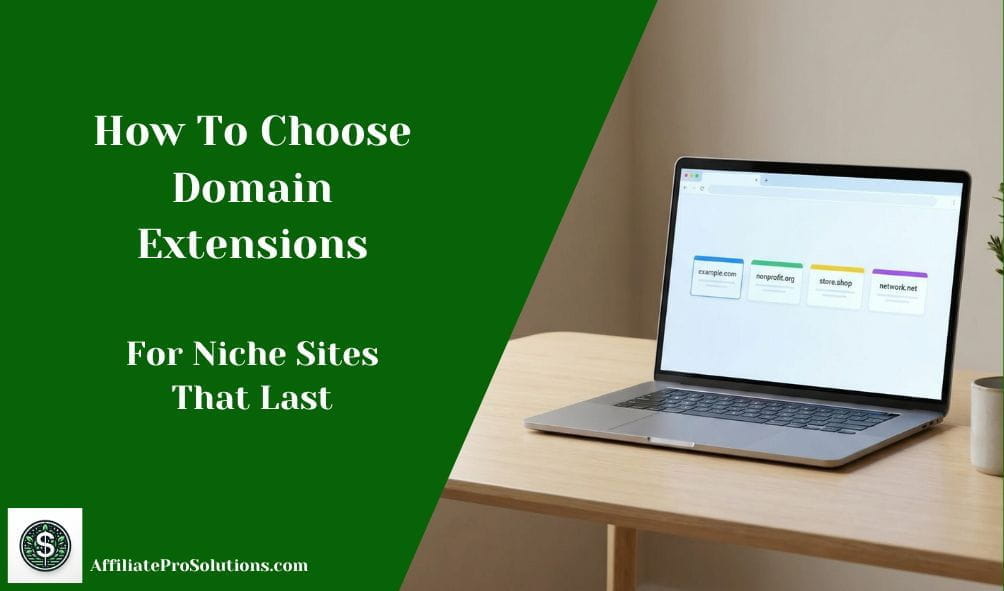
Topic – Getting Started/Beginners
Post Reading Time – 26 Minutes
If you’re trying to build a niche site and you already feel stuck at the domain stage, I know how you feel. I’ve seen it happen so many times. People spend so much time trying to find the right name, only to hit a brick wall when they realise the extension doesn’t feel right or isn’t available, and suddenly the whole process feels a lot more frustrating than it should.
Knowing how to choose domain extensions for niche sites is something most people don’t really think about properly when just starting out. I mean, most people have probably never even heard the term before. The first they learn of it is when they’re buying a domain name and they’re already on the checkout screen. By then though, it often feels rushed and a lot of us just pass through this stage giving it little to no thought at all. The truth is, the extension shapes how your site is seen, how trustworthy it feels, and how clear your topic comes across to someone seeing your website or blog for the first time.
I’ve learned over the years that choosing the name and the extension together can save you from a lot of frustration. When both parts feel natural together, the domain is easier to remember, easier to share, and easier for visitors to feel comfortable clicking on. The extension won’t lift your site to the top of the search results on its own, but it does help set some expectations. And for a niche site, a good early impression matters more than most people realise.
How To Choose A Domain Extension For A Website
To choose the domain extension for your website you need to first understand what the extension signals to the person seeing it for the first time. The extension is the part that comes after the dot, such as .com or .org, and while it looks small, it plays a big role in trust, clarity, and first impressions.
Start off by thinking about who the website is for. If the goal is to reach a broad audience, the more popular extensions will feel more comfortable because people recognise them straight away. If the site is focused on a specific topic, service, or location, an extension that reflects that will help visitors understand what the site is about without having to think twice.
The extension should read naturally with the name and feel easy to say out loud. If it looks strange, confusing, or raises questions, it usually creates hesitation. For niche sites especially, the aim is clarity. A good extension supports the name, feels appropriate for the topic, and gives visitors confidence before they even click through to read your content. Many guides focus on listing extensions. What they often skip is how the extension affects trust and future growth. See your full domain extension checklist here!
What You’ll Learn From This Post
- How to choose domain extensions for niche sites with confidence – You’ll learn how domain extensions create first impressions and how to choose one that feels right for your niche.
- Which domain extensions are good for different types of niche websites – This covers popular, niche focused, and location based extensions, and when each one is worth considering.
- How domain extensions influence trust and clarity – You’ll see how the extension can affect how comfortable people feel clicking through to your site for the first time.
- When the more popular extensions are the better option – This explains why well known extensions often feel safer and easier for visitors, especially in certain niches.
- How to avoid domain extension choices that cause problems later – You’ll learn how to think ahead so your domain still feels right as your site grows, instead of needing a change later.
Summarize This Content Using AI

Start Your Training
- Build Your Website & Earn Revenue
- Support, Tools & Training Included
- Complete with Business HUB
- Artificial Intelligence Writers
- My Personal Support
- No Risk Free Starter Account
- FREE BONUS AI CREDITS
TL;DR
How to choose domain extensions for niche sites
Domain extensions can limit or open up your options when you’re setting up a niche site. This post looks at the differences between extensions and how they can affect availability and use later on. It’s meant to help you make a good choice before you go registering anything.
Why Domain Names And Domain Extensions Work Together
The domain name and the extension should be thought of as one complete address, not two separate choices. When they go well together, the site feels clearer and more confident from the very start. If the name sounds good but the extension feels out of place, it can create doubt before someone even visits the site.
This is especially important for niche websites, where people rely on quick signals to decide if a site is relevant to them or not. A mismatched combination can cause people to hesitate or it can create confusion, and in some cases even lead visitors to type the address incorrectly or end up somewhere else.
Choosing the name and extension together helps avoid that situation. When both parts read naturally as one, the domain is easier to remember, easier to share, and feels more reliable right from the beginning.
How Domain Extensions Influence Trust And Search Visibility
The domain extension you choose shapes how people feel about your site more than where it appears in the search results. The search engines don’t place a site higher or lower just because the extension looks modern or because it’s popular. That part is often misunderstood.
What does matter is how the extension comes across to someone seeing your site for the first time. If it feels clear and familiar, people are more likely to trust it and click through. If it feels odd or confusing, they will be hesitant to visit you, even if your content itself is something they might be interested in.
For niche sites, this early reaction is really important. The extension helps set expectations before anyone reads a word on the page. It doesn’t push rankings on its own, but it can influence how confident visitors feel about giving your site a chance in the first place.
Common Types Of Domain Extensions Explained
When you start looking at domain extensions, the number of choices available to you can feel a bit much at first. So, you’ll be happy to know that most extensions fall into a few clear groups.
Once you understand what each group is used for, it will be a lot easier to decide which direction feels right for your niche site.
If you want a clear overview of how domain extensions are structured and managed, this official guide from ICANN explains the different types and what they’re used for.
Each type sends a slightly different signal to visitors, and some are better suited to certain goals than others.
Below are the main categories you’re most likely to come across.
Generic Extensions Like .com, .net, And .org
Generic extensions are the ones most people recognise straight away. When someone thinks of a website address, .com is usually the first thing that comes to mind. These extensions have been around for a long time, which is why they feel more familiar and are trusted.
A .com extension works for almost any type of website and it often gives the impression that the site is open to a wider audience. A .net extension started out around network related projects but is now used in many different ways. A .org extension was originally linked to organisations and nonprofits, and while it’s used more broadly now, it still carries a sense of trust and community.
Because people are so used to seeing these extensions, they’re easy to remember and rarely cause any hesitation when someone is deciding whether to click or not.
Country Specific Extensions Like .uk, .ca, And .de
Country specific extensions are tied to particular locations. These are known as country code top level domains and they help signal where a website is based or who it is mainly for.
If a niche site is aimed at one country or region, this can help visitors feel more comfortable straight away. Someone in Canada, for example, will feel more confident clicking a .ca site when they’re looking for local information or services.
These extensions can also help with local visibility in the search results for that country.
The downside to these is that they can make a site feel limited to one location, even if there are plans to expand later.
That’s why it’s worth thinking about how local or broad the site is meant to be in the long run.
Industry Or Niche Extensions Like .shop, .cafe, .design, And .tech
Industry extensions are designed to give instant context. They tell people what the site is about before they even land on the page.
A coffee related site using .cafe or .coffee makes its topic obvious. A technology site using .tech does the same. These extensions can help a niche site feel clear from the beginning.
That said, not everyone is familiar with every newer extension. If the audience isn’t used to seeing them, they can sometimes cause uncertainty.
With this in mind, it’s a good idea to check whether the extension feels natural to the people the website is meant for.
Trend Driven Extensions
Some extensions become popular quickly because they are tied to current online habits or to new types of content. Extensions like .blog, .live, or .app fall into this group.
They can feel current and relevant at the time, especially if the audience already uses them elsewhere.
The risk is that trends change. An extension that feels current today may not carry the same weight a few years from now, so it’s worth thinking about how well it will age.
Restricted Extensions Like .edu, .gov, And .bank
Restricted extensions are only available to certain groups that meet specific requirements. Educational institutions use .edu, government bodies use .gov, and licensed banks use .bank.
These extensions are trusted because they cannot be registered by just anyone.
While they are not available for niche sites, it helps you to understand what they represent so you know why people trust them when they see them.

Familiar And Relevant Domain Extensions For Niche Sites
People generally feel more comfortable when they recognise what they’re looking at.
Using a well known extension like .com or .net usually feels familiar, which makes it easier for visitors to trust the address and remember it later. That’s a big reason these extensions are still taken so quickly.
Using a less common extension can still be a good option, especially when it clearly reflects what the site is about.
For example, a jewellery site using .jewelry gives visitors an immediate idea of the topic. The thing to keep in mind is how familiar your audience is with that type of extension. If it feels unfamiliar to them, it can cause a pause or lead to people second guessing what to do next.
Keeping Things Clear Instead Of Clever
There’s nothing wrong with being creative and having good ideas, but with domain extensions, being clear is better. If someone understands what your site is about as soon as they see the address, that removes any doubt and makes the decision to click that much easier.
Extensions that need explaining or feel unusual can distract from the name itself.
For niche sites especially, it helps when the address does its job quietly without asking visitors to think too hard about it.
Readability And Trust
The extension might not draw attention to itself, but it still affects how the whole address feels.
What matters most is that the domain reads naturally from start to finish, is easy to say out loud, and doesn’t feel difficult when it’s shared.
You don’t need to have a perfect word pairing. It’s just important that the full address feels comfortable and reliable when someone sees it for the first time. When it reads smoothly and sounds natural, trust usually follows.
Choosing A Domain Extension Based On Your Audience
Knowing who the people are who’ll use your site should guide many of your early decisions, and the domain extension is all part of that. Different audiences respond to different signals, so it always helps to think about where people are located, how they browse online, and what they’re used to seeing.
Some visitors prefer familiar ground, while others can be more open to new ideas. Having that in mind makes it easier to choose an extension that feels right for the people you want to reach.
Location And Local Trust
If most of your visitors are based in one country, a local extension can help your site feel more relevant straight away. A .ca address for a Canadian audience or a .ie address for Irish readers can make the site feel a lot more personal and easier to trust.
People often respond better when they feel a site was made with them in mind. A local extension can give that impression before they even click through.
Thinking Beyond One Country
If the site is aimed at people from different parts of the world, or the topic isn’t tied to just one place, a more widely recognised extension is usually a better choice. Extensions like .com or .net feel open and familiar to visitors from many regions.
Some niche focused extensions can also work here, as long as they are easy to understand and don’t feel limited to one location.
Audience Comfort And Familiarity
Some niches attract people who prefer things to feel familiar and straightforward. Topics like finance, health, or education often fall into this group, where well known extensions feel more reassuring.
Other niches attract people who are more open to new ideas. In those cases, using a more modern extension can feel natural and accepted. The important thing is to choose something that feels comfortable for the people you expect to visit, rather than what looks interesting on its own.
Additional Beginner Info & Resources
How Domain Extensions Affect Clicks And Search Listings
There’s a lot of confusion around how domain extensions affect search visibility. The extension itself doesn’t control where a website appears, but it does influence how people react when they see your site listed.
Here’s what actually matters.
- Search engines don’t rank a site higher or lower just because of the extension
As long as a site is properly set up and not linked to spam, most extensions are treated the same. - People notice extensions when browsing the search results
Familiar extensions feel safer, which can make people more willing to click. - Click behaviour can affect how a site performs over time
If visitors trust the address and choose it more often, that can help support visibility naturally. - Country based extensions can help with local visibility
If a site is aimed at one country, a local extension can help it appear more often to users in that area. - A flexible extension helps if the site may grow later
If you plan to grow beyond one area, it helps to choose an extension that won’t feel out of place later on.
Support, Not A Fix
A relevant domain extension can help people feel comfortable clicking through, but it doesn’t solve the bigger things that matter once someone arrives.
If the content is unclear, the layout is untidy, the site feels unfinished, or the topic isn’t obvious, visitors will still leave. The extension can encourage the first click, but everything that follows depends on the website itself.
Domain Extensions And Brand Recognition
Strong domain names feel easy from the first glance you take at them. They sound natural when spoken, are simple to read, and the extension feels like it belongs there. A good domain needs to be easy to remember so people can come back without having to think about it.
When the name and extension sit comfortably together, the whole address comes across as settled. That kind of familiarity helps people recognise your site again later, which matters a lot for niche websites built around repeat visits.
Natural And Easy To Say
One of the simplest checks is to say the domain out loud a few times. If it flows without effort and doesn’t need explaining, that’s usually a good sign.
The extension should feel like part of the name rather than something added on at the end. When a domain is easy to say and easy to spell, it’s easier for people to share it, remember it, and come back to it later.
Making It Easy To Remember
Trying to be too clever with a domain can cause problems. Some ideas look good on the screen but don’t stick in people’s minds.
If visitors have to stop and think about how to type the address, or which extension it uses, that’s a sign the domain may be doing more harm than good. A memorable address doesn’t need to be clever. It just needs to feel clear and familiar enough that people remember it naturally.
Living With The Domain Over Time
It’s worth choosing a domain you’ll still feel comfortable using years from now. You’ll be writing it, sharing it, and building around it for a long time.
Extensions that feel appropriate age better than ones tied closely to short term ideas. Picking something that still feels right as the site grows can save you from needing to change things later on.
Legal And Safety Checks When Choosing A Domain Extension
Just because a domain is available to register doesn’t mean it’s completely free of risk. Before committing to a name and extension, it’s worth taking a bit of time to check that the full address won’t cause you problems later.
Here are a few things worth checking before you buy.
- Look for trademark conflicts
Even if a domain appears to be unique, names that are close to established brands can create issues once a website gains visibility, regardless of the extension that is used. - Avoid names that resemble existing businesses
Similar sounding or looking domains can confuse visitors and, in some cases, they can lead to legal warnings that are difficult to deal with after the site is live. - Check how the full address comes across
The combination of the name and the extension should feel clear and honest. If it could mislead visitors about what the site offers, it’s best to avoid it. - Run a basic online search
Searching the full domain idea can quickly show if it’s already associated with a business, product, or service you were not aware of. - Use a simple trademark lookup
Take a few minutes to check the name and the extension together, as this can prevent problems later and give you peace of mind before registering.

Domain Extension Costs And Availability
This is one of the more practical parts of choosing a domain, and it’s also one that often catches people off guard. The extension that feels most obvious isn’t always available, and when it is, the price can sometimes be higher than you expect.
That doesn’t mean you’re stuck though. Different extensions open up different options, and some can give you more flexibility without lifting the cost too high.
The Cost Of Common Extensions
Well known extensions like .com or .net come with a higher demand. Short, clear names using these extensions are often already taken, and in many cases they’re being resold at a much higher price.
If you find a .com that is good for your site and it sits within your budget, it’s usually worth serious consideration. These extensions are familiar to most people and rarely raise questions, which is why they’re often priced higher in the first place.
More Flexibility With Newer Extensions
When a name you like is no longer available with a common extension, newer options can open things up again. Extensions such as .store, .site, or .guide often have more availability, which can give you more freedom with the wording of your domain.
They can also be easier on the budget, especially when you’re starting out.
This makes it possible to secure a clear and relevant name without needing to settle for something awkward or overly long.
When Lower Cost Options Can Work
Lower priced extensions can be appealing, especially when you’re watching your expenses closely. In some cases they’re perfectly fine, as long as they’re appropriate for the topic and don’t raise doubts for visitors.
The important thing is how people react when they see the full address. If the extension feels unfamiliar in a way that causes uncertainty, it can undo the benefit of saving money at the start.
Finding A Balance Between Price And Confidence
It’s usually better to change your name slightly or wait a bit longer than to choose an extension you don’t feel comfortable with. A domain is something you’ll be sharing often, and if it feels unclear or causes hesitation, that feeling tends to stick with people.
Choosing an extension that feels steady and appropriate often pays off, even if it means spending a little more or taking a bit longer to decide.
Planning Ahead When Choosing A Domain Extension
The domain extension you choose should still feel right as the site grows.
I know it’s easy to look at how things are today, but niche sites often change over time. Topics can widen, audiences can change, and what starts small can become something a lot bigger.
The problems tend to show up when an extension feels too narrow. A site can grow in traffic and content, but the extension quietly holds it in place, making the whole project feel boxed in later on.
Leaving Room To Expand
If there’s even a small chance the site could cover more topics, offer new products, or reach a wider audience in the future, it helps to choose an extension that won’t limit that growth.
Local extensions are good when a website is clearly tied to one country and will stay that way. But if there’s any uncertainty, a more open extension can save you from needing to rethink things later on.
Choosing something flexible early on will keep your options open and it avoids unnecessary changes down the road.
Being Careful With Trend Based Extensions
Some extensions gain attention quickly because they line up with popular topics or short term interests. While they can feel current at first, that appeal doesn’t always last.
If the interest fades away, the extension can start to feel dated, even if the content itself is still useful. For long running niche sites, it’s usually safer to choose something that won’t feel tied to a moment in time.
Why Changing Domains Later Is Hard
Switching to a new domain after a website is established is never simple. Visitors may not recognise the new address, links need updating, and trust takes a lot of time to rebuild.
Even when everything is done carefully, there’s often a period where traffic drops and momentum slows.
Making a thoughtful choice early on will avoid that situation and lets you concentrate on building the site instead of fixing it again later.
A Simple Checklist To Choose A Domain Extension

| Be clear on what the site is about and who it is for | If the niche and audience are not clear, it becomes much harder to choose an extension with confidence. |
| Decide if the site is local or meant to reach a wider audience | This helps you to avoid picking an extension that feels limiting once the site grows. |
| Look around and see what other sites in your niche are using | A quick look at some similar sites shows what visitors are already comfortable with. |
| Avoid extensions linked to spam or low trust | A cheap or an unusual extension can cause hesitation before anyone even visits the site. |
| Say the full domain out loud | If it sounds natural and is easy to remember, that’s a good sign. |
| Only register once the name and extension feel right together | When both parts work as one, you can move forward without worrying about your choice. |
If you can tick every item on this list without hesitation, you’re unlikely to regret your domain choice later.
Frequently Asked Questions – FAQs
To choose the right domain extension you need to start by understanding what the website is for and who it is meant to reach. The extension sends a signal before anyone visits the site, so it should feel appropriate for the topic and familiar to the audience.
A site aimed at a broad audience will usually feel more comfortable with a widely recognised extension, while a site focused on a specific topic or location can benefit from something more descriptive. The idea is to choose an extension that feels natural, clear, and easy for visitors to trust at first glance.
For most websites, .com feels more familiar to people and it is easier to remember. That familiarity often helps visitors feel more comfortable clicking through. A .biz extension can still be suitable for certain business focused sites, but it is less common and may raise questions for some visitors.
If there is any uncertainty, .com usually feels like the safer and more widely accepted option.
Both extensions can work, depending on the audience. A .com address tends to feel familiar across many industries and age groups, which makes it a good choice for general or mixed audiences. A .io extension is often seen on technical websites and it can feel normal there.
The decision comes down to what your audience is used to seeing and what feels most comfortable for them when they see your site listed.
Some domain extensions appear far more often than others. The most common ones people tend to recognise are .com, .org, .net, .info, and .biz.
These have been around for a long time, which is why they feel familiar and easy to trust. Seeing one of these extensions rarely causes hesitation, especially for people who are not deeply involved in online projects.
There is no single extension that is best for every website. The right choice depends on the topic, the audience, and how the site may grow over time. An extension that feels clear, familiar, and appropriate for the subject usually performs better than one chosen simply because it looks interesting.
The best extension is the one that supports the site naturally and feels comfortable for the people you want to reach.
What I Learned From My Own Domain Decisions
If I’m being honest with you, I’ve made both good and bad choices with my domain names. I remember one time I picked a clever sounding name with a popular extension because it suited the niche at the time. A few years later, that popularity faded away and the domain no longer felt right.
People mistyped it, and I could tell it didn’t carry the same level of trust as the more familiar extensions.
I’ve had better results when the extension matched the type of site I was building. Using a .org for a resource based site or a .shop for an ecommerce project made the purpose clearer and easier for visitors to remember. Those domains felt more settled and easier for me to commit to long term.
That experience taught me to slow down before registering anything. Now I ask a few simple questions. Is it easy to say? Does it feel normal for the audience? Does the extension suit the topic without limiting future plans? If it does, I move on with confidence.
If You’re Still Unsure Where To Start
If you’re feeling stuck at this point, I completely understand. Choosing a domain extension sometimes feels harder than it should be, especially when there are so many options on the screen.
A good place to begin is with the familiar choices. Try the name you like with a .com first and see how it feels. If that’s not available, move through other well known options like .net or .org, or a niche focused extension that clearly reflects what the site is about.
If your site is aimed at one country, checking your local extension can also be a good idea. For broader topics or mixed audiences, it usually helps to stick with something that doesn’t feel tied to one place.
Before deciding, say the full address out loud and picture sharing it with someone else. If it sounds clear and natural, you’re on the right track.
Once the name and extension feel right together, it’s usually best to just move forward and begin building.
One More Thought on Domains And Niche Sites
I appreciate you going through all of this with me. I know choosing the right domain extension can feel like a small detail, but it shapes how your site is seen from the very beginning. When the name and extension sit together nicely and feel right for the niche and audience, everything else tends to feel more straightforward.
I always recommend slowing down at this stage rather than rushing through it. A well chosen domain makes the early stages of building a site feel more settled and helps avoid unnecessary changes later on.
Getting this part right can save time, money, and a lot of hassle down the line.
If you’ve got any questions, different experiences, or something you’re unsure about, feel free to get in touch. I’m always happy to share what’s worked for me and help where I can.
Thanks for reading, and feel free to leave your thoughts or questions below.
Chris
Wealthy Affiliate
This is where my journey into the online world began, and it’s still the community I use for learning, tools, and support while working on my own projects.
About Chris Towers – Follow Me

My name is Chris Towers, and I run Affiliate Pro Solutions. I work with websites, content, and affiliate projects, and this website is where I share what I’ve learned from doing that work.
Most of what I write about comes from researching hosting companies, tools, and platforms that people use when building websites or trying to earn online. I look at how things are set up, what’s included, and where people often get caught out later.
I’m not connected to the companies I review beyond standard affiliate partnerships. This site does include affiliate links, but the aim here is to explain how the services work rather than push anyone into a decision.
You’ll find me on
Related
- How To Choose Domain Extensions For Niche Sites

- What Should I Do If My Domain Name Is Taken? Your Next Steps
- Starting An Online Business While Working Full Time & Succeeding
- The Ways To Avoid Scams Online and Keep Yourself Safe
- The Best Sites For Building Your Own Website On – Expert Picks!
- Top 5 Mistakes To Avoid When Starting An Online Business





Just to be open with you, this page includes affiliate links. If you click on one of these links and make a purchase, I earn a small commission. There is no extra cost to you at all. This simply helps support the content I share here. Thank you for your support, it really is appreciated.
Thanks for this Chris. The part about choosing the name and extension together was something I never thought about before. It’s easy to rush that step and regret it later.
It’s a good reminder to slow down and think it through before registering anything.
The checklist at the end was helpful too. It makes the decision a lot easier.
Glad you found it useful. Choosing the name and extension together is one of those things people usually only think about after the fact.
The checklist came from mistakes I’ve made in the past, so if it helps someone slow down before registering a domain, then it’s done what it’s meant to do.
Appreciate you reading.
Thanks
Wow, this post really made me stop and think. Just to clarify, if I understand correctly the extension is when you add an article to your site and the title normally becomes the extension? Or are you talking about adding a whole new site with your domain and the name of the new site behind it.
If it is what I think it is, then no I have never thought about the extension much apart from targeting the keyword that I need to for that specific article. I love your idea of making the words run from your domain in a way that makes people remember it better so that they can find the site again.
I am going to put some more thought into this from now on before I hit publish.
Thanks, Michel, I’m glad it got you thinking.
Just to clear something up, I’m talking about the end of the website address itself, like .com or .net, not the titles or links of individual posts.
Most people don’t really think about that part when they’re starting out, so it’s an easy thing to miss.
For example, on this post https://affiliateprosolutions.com/how-to-choose-domain-extensions-for-niche-sites/, the .com is the domain extension. The part that comes after it is just the page or the post name.
Once the domain is set, everything you publish sits under it, which is why it’s worth slowing down and thinking about it early on.
Hope that helps clear things up.
Chris