

Topic – Keyword Research
Post Reading Time – 25 Minutes
I know all too well that trying to come up with good keywords can be frustrating, especially when you sit there staring at a blank page with no idea where to start. I’ve been there myself. You might know your topic well, yet you still struggle to turn it into phrases people actually type into Google.
That’s why learning some effective ways to brainstorm keywords is important for making headway. When your ideas are solid right from the start, everything else becomes easier later, from planning your content to attracting visitors who are actually interested in what you offer.
In this post, I want to show you how I go about keyword brainstorming, what helps, what usually wastes time, and how to keep the ideas flowing even when your mind feels empty.
What Are Keywords and Why Do They Matter?
If you’re searching for ways to brainstorm keywords, it always helps to start off with the basics. Keywords are the words and phrases people type into Google and the other search engines when they want answers, help, or solutions for something. Good keyword ideas come from real language, not from industry talk or internal terms. I always look at how people actually describe their problems, because that’s what they search for.
The search engines then use those phrases to decide when a page should appear in the results. When your keywords match those searches, your content is more likely to reach people who are already interested. That’s why getting the wording right early on makes everything else easier later.
What You’ll Learn From This Post
- Finding Real Search Language – Looking for the words and phrases people actually type into the search engines, not industry terms or internal wording that sounds perfect but rarely gets searched for.
- Starting With Brainstorming – Look at ways to find keywords before you look at the search volume or competition, so you are working with good ideas rather than limiting yourself too early.
- Writing Ideas Down Before Judging Them – Get as many keyword ideas down as possible at the start, then narrow them down later once you have a better idea of what’s worth using.
- Looking At Problems And Solutions – Pay attention to how people describe their problems and what results they want, as this often leads to keyword ideas that will attract the right visitors.
- Revisiting Your Keyword Ideas – Come back to your keyword list from time to time, since search habits can change and new opportunities can appear when you least expect them.
Summarize This Content Using AI

Start Your Training
- Build Your Website & Earn Revenue
- Support, Tools & Training Included
- Complete with Business HUB
- Artificial Intelligence Writers
- My Personal Support
- No Risk Free Starter Account
- FREE BONUS AI CREDITS
TL;DR
Ways to brainstorm keywords
To brainstorm keywords you need to think about the words and phrases people actually type when they search so your content reaches the right readers. This post goes through the ways to come up with keyword ideas that link naturally to what you write about. Using these methods helps you concentrate on topics that matter to your audience.
How Keyword Brainstorming Fits Into SEO
Keyword brainstorming comes right at the start of SEO. It comes before the tools, before numbers, and before worrying about the competition. This is the point where I slow things down and concentrate on getting ideas out of my head and onto the page without judging them too early.
Once I’ve done that, keyword research becomes much easier for me to handle. With a list of ideas in front of me, I can then look at the search volume and competition to see which ones are worth keeping. From there, I build content around the stronger options, keep an eye on what performs well, and make any changes when I think they’re needed.
Also, search habits don’t stay the same, so this isn’t something I do just once.
I come back to my keyword lists regularly, add some new ideas, and stay on top of things so they stay relevant. Brainstorming gives me the raw material and everything else builds on that afterwards.
Understanding Your Niche Before You Start Brainstorming
Before I start brainstorming, I make sure I understand my niche properly. This saves me a lot of time later and stops me from coming up with ideas that I don’t really need.
I like to break a niche into smaller parts instead of treating it as one big subject. When you do that, it becomes a lot easier to see where keyword ideas can come from and how the different areas all connect. Those smaller areas usually lead to more specific searches, which is exactly what you want when you brainstorm keywords.
I also spend some time thinking about the problems and needs people have in that niche. When you understand what people are trying to fix or improve, your keyword ideas tend to come more naturally and feel more useful from the start.
Think Like Your Audience, Not Like an Expert
One really easy mistake to make is forgetting how most people actually search for something once you know a subject inside out.
When that happens, it’s tempting to use words and terms that make sense to you but would never cross the mind of the average person. I try to step away from that and look at how people really speak when they’re searching for help online.
I stick with everyday language and stay away from jargon talk unless I know for sure it’s something people search for. The best clues usually come from how questions are asked, not how subjects are explained.
A lot of my keyword ideas come from paying attention to people’s comments, emails, and messages. When you listen closely to the words people use, you’ll see patterns, and those patterns can lead you to some of the strongest keyword ideas.
Brainstorming Around Core Topics
Every website naturally has a small number of main topics. These are the subjects you come back to again and again when creating content, and they usually reflect what your site is actually about.
Starting with those main topics makes brainstorming a lot easier. When you know the areas you want to cover, ideas will come to you more naturally and they’ll stay relevant instead of drifting off into things you don’t actually need.
Once those basics are clear, it helps to think a bit wider.
Related subjects and supporting ideas can still lead to strong keyword ideas, even if they’re not something you cover directly. These kinds of topics will often attract the people who are already interested in the subject and want more detail.
It’s also worth paying attention to how people talk about these topics in everyday language. Different wording, alternative phrases, and even small variations can be useful to keep in mind if you know people actually use them when searching.
Brainstorming Around Problems and Pain Points
Problems are often where the best keyword ideas come from. When people are frustrated or stuck with something, they have a need to search for help straight away. That usually means they use very direct questions, written in plain language, and exactly how they’d ask them out loud.
These searches also show us clear intent. Someone typing a problem into a search engine is usually looking for an answer now, and not just browsing. Looking at these kinds of searches helps you come up with keyword ideas that feel natural and ones that closely relate to what people are actually looking for.
Paying attention to how problems are worded is important. When the phrasing shows how people really talk, the keyword ideas you uncover are often more useful and easier to build content around later.
Brainstorming Around Solutions and Outcomes
Not everyone searches by describing a problem. In fact quite often, people go straight to what they want to achieve. So instead of typing out an issue, they’ll search for the result they’re hoping for or the thing that will help them get there.
This is where thinking about solutions starts to help out. People might look for tools, products, or methods that promise a certain result, rather than explaining what’s wrong. Looking at this way of searching opens up a different set of ideas that are just as useful.
It helps to listen to how people describe the outcome they want. Phrases that point to improvement, relief, or progress will often turn into strong keyword ideas that are easy to build content around and feel natural to the reader.
Brainstorming Features and Specifics
Details start to matter a little bit more once people are closer to making a decision. At this stage, searches often include things like specific features, requirements, or questions that narrow things down a bit. These might be about price, location, size, or a particular use, rather than just a broad topic.
Being more specific usually works in your favour.
Fewer sites cover these kinds of searches, which makes them easier to work with. When you pay attention to details like colours, sizes, locations, or how something is used, you can end up with keyword ideas that feel clearer and have more purpose or intent.
This kind of thinking will help you to build a list that’s full of ideas people actually search for when they know what they want and are ready to take the next step.
Considering Alternative Solutions
Sometimes people look around before settling on a particular option. Instead of searching for one direct answer, they compare different ways of solving the same problem. These kinds of searches often show up quite early, while someone is still deciding what to do.
Thinking about alternatives can show us some useful keyword ideas. This means taking a look at different methods, tools, or the ways people might consider doing something instead of the obvious choice.
It’s always best to stay away from brand names or anything trademarked and keep things more general. Everyday wording often works better here.
This way of thinking helps you reach people while they’re still weighing things up, which can be a good place to be.
Using Modifiers to Expand and Refine Ideas
Very short keywords are usually too broad to be of any use. One or two words on their own don’t tell you much about what someone is looking for, and they’re more difficult to work with because so many sites are targeting them.
Adding a few extra details helps to narrow things down. Words that point to the price, time, experience level, or situation can completely change the meaning of a search and make it much clearer.
The same goes for the location, especially for local businesses, where people will include where they are or what’s nearby.
When you start adding these kinds of details in, your ideas naturally become more specific. That usually leads to keyword ideas that make more sense, feel more realistic, and are easier to build your content around.
Putting Keyword Brainstorming Into Practice
To show how this works in real life, I want to take you through a simple example. Nothing special. Just the thinking process on paper.
Before putting this into practice, here’s a quick reminder from above of the different angles you can use when brainstorming keyword ideas:
- Starting with your main or core topics
- Looking at problems and pain points
- Thinking about solutions and outcomes
- Adding features and specific details
- Considering alternative ways people might search
- Using extra details to narrow things down
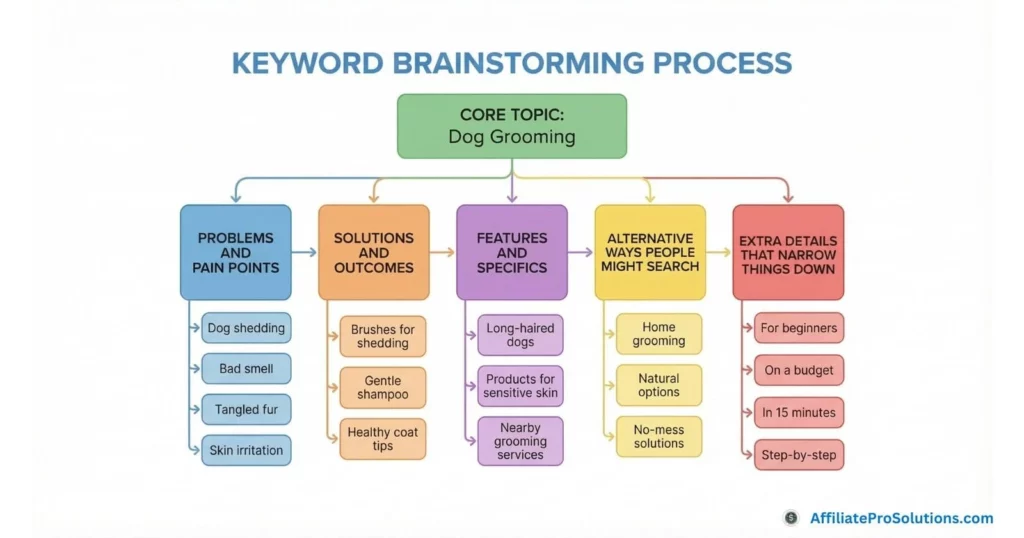
This is the same thinking process shown step by step in the example below. Click To Enlarge.
So let’s say for example the topic is dog grooming.
You’d start with the main topic itself. That’s your starting point. From there, ideas will naturally branch out once you stop thinking in terms of keywords and start thinking about how people actually search for things to do with dog grooming.
Next come the problems. People might be dealing with dog shedding, bad smells, tangled fur, or skin irritation. These things usually turn into searches written as questions or frustrations, often typed exactly how someone would say them out loud.
Then there are solutions and outcomes. Instead of searching for the problem, someone might look for things like brushes for shedding dogs, gentle shampoo, or ways to keep a dog’s coat healthy. These searches point to what the person wants to fix or improve.
From there, things get more specific. Searches often include details like dog size, coat type, price range, or location. Someone might be looking for grooming tools for long haired dogs, shampoo for sensitive skin, or services nearby.
There’s also the option of looking at alternatives. Some people don’t search for the main solution at all and instead look for different ways of dealing with the same thing. In this case, that could mean searches around home grooming instead of professional services, natural products instead of branded ones, or ways to manage grooming without using certain tools.
Finally, adding a few extra details helps narrow things down even more. Words related to experience level, budget, timing, or situation will often appear at this stage. These small additions usually turn a general idea into something much clearer and easier to work with.
All of these ideas come from one simple topic. Nothing here comes from tools or data yet. It’s just a way of thinking through how a topic naturally expands once you look at it from different angles.
Why this example matters
It matters because you can apply the same process to any subject. The goal isn’t to find the perfect phrase straight off the bat. It’s to build a good list of ideas that reflect how people actually search, so the next steps feel far less complicated.
Long Tail Keywords and Why They Matter
Long tail keywords, basically, are longer and more detailed search phrases. If you want a fuller explanation, I’ve written a guide on what a long tail keyword is.
Instead of one or two broad words, they include some extra context that shows what someone is actually looking for. These searches usually don’t get a massive amount of traffic, but they do tend to be much clearer and more targeted.
When someone types a long phrase into a search engine, they usually know what they want. They’re not just browsing. They’re looking for a specific answer, a product, or solution, which makes these kinds of keywords very useful when you’re planning your content.
Long tail keywords are worth paying attention to because:
- They’re usually easier to work with since fewer sites target them
- They show clear intent, so you know what the searcher is trying to do or achieve
- They attract visitors who are more likely to take some sort of action
This is also the stage where adding in some extra details really helps. Some small additions like experience level, budget, timing, or a situation can turn a vague idea into something much clearer.
That’s where the strongest keyword ideas start to appear from.
To make this clearer, let’s go back to the dog grooming example
A broad idea might be something like dog grooming tools. Now on its own, that doesn’t tell you much. It could mean anything, and it’s also very competitive.
Once you start adding more details though, the search becomes more specific. Someone might search for the best grooming brush for long haired dogs, or dog shampoo for sensitive skin at home.
These longer phrases show us exactly what the person is trying to find.
By the time a search includes details like dog type, coat length, skin issues, or where the grooming will happen, the intent is much clearer.
This is why the longer search phrases are easier to build content around. You don’t need to guess what the reader wants. The search itself tells you what you need to know.
Additional Keyword Research Info & Resources
Where to Find Keyword Inspiration
A lot of good keyword ideas come from everyday life. Real questions, conversations, and the comments people make without thinking about SEO will often contain the exact wording others use when they search for something.
If someone asks you for advice, or messages you on social media with a question, there’s a good chance that the same phrase has already been typed into Google. Those moments are worth paying attention to. They give you natural language and not something that’s forced.
Offline experiences can help you as well.
Things you overhear in everyday places, topics that keep coming up on TV, or even headlines in magazines can give you ideas. These can often reveal how people actually talk about their problems and interests, which is easy to miss when you only rely on online tools.
Using Search Behavior to Expand Keyword Ideas
Search engines themselves are another helpful source.
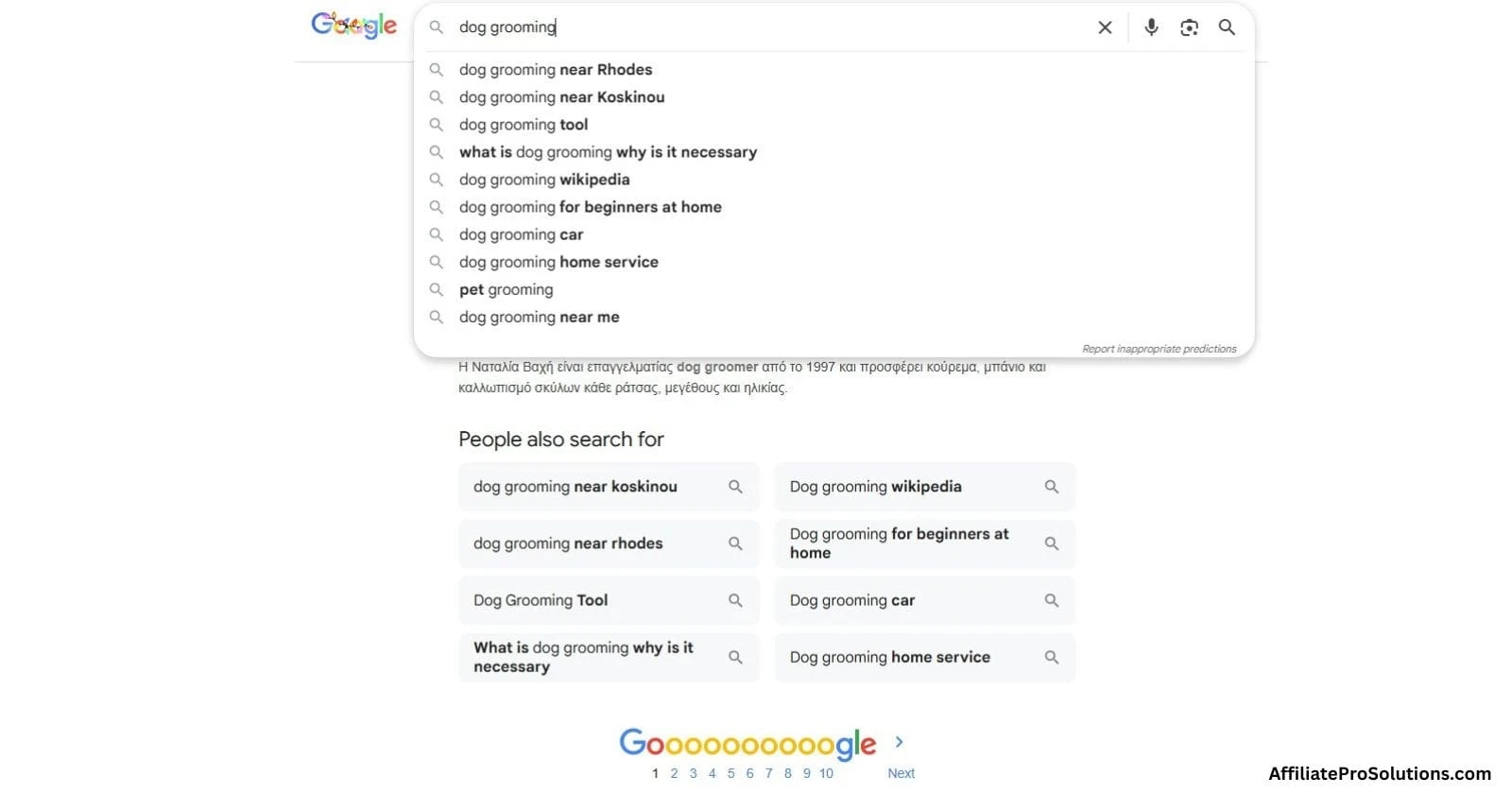
As soon as you start typing something into Google, the suggestions that appear are based on what people are already searching for. This gives you a quick look at some of the common phrasing and related ideas without any extra effort on your part.
Google also explains in more detail how search engines understand and process searches, which helps make sense of why these suggestions appear in the first place.
Scrolling to the bottom of the results page can help as well. The related searches section often shows variations and angles you may not have thought about, but that still connect closely to your original idea.
Adding these suggestions into your brainstorming helps you to widen your thinking. You just need to understand how people naturally search for something and let that guide your ideas before you ever touch a tool.
Other Places to Look for Keyword Ideas
Keyword ideas don’t just come from using tools or the search engines. A lot of the useful wording comes from places where people ask questions or share their opinions in their own words.
Places like forums and Q&A sites are a good place to start. When people explain a problem or ask for some advice, they usually do it without overthinking the wording. That kind of language is what can be used for strong keyword ideas.
Looking at other websites in your niche can help as well.
Look at page titles, headings, and topic choices as these can give you clues about how certain subjects are being discussed and what different angles are being covered.
Video platforms and visual sites can also give you some good ideas. The titles and descriptions often reflect what people are curious about or actively searching for, especially in the more popular or practical topics.
Reviews and comments are another useful place to look. When people talk about what worked for them, what didn’t, or what they were hoping to find, they’re usually very direct. That wording is often worth paying attention to.
Online shops can help you as well. Product categories, customer questions, and reviews will often reveal how people describe different features, problems, or expectations in everyday language.
Using a mix of all these places will help you build a thorough and useful list. You don’t need to copy anything, but just notice how people naturally talk about the things they’re searching for.
Organizing and Filtering Your Keyword Brainstorming Ideas
Once you’ve got together a good list of ideas, the next step is to bring a bit of order to it all. You don’t need to start cutting things out just yet though. This next step just helps you to turn a list into something you can work with.
I usually put everything into one place so I can see it all together. From there, it helps to group the ideas by topic and by intent. Some of the searches are clearly about learning, some are about comparing different options, and others show that someone is ready to take action.
This makes it a lot easier to decide what to concentrate on first.
At this stage, I don’t worry too much about the numbers side of things. The main thing here is to pull out ideas that are useful, clear, and realistic.
Even ideas that might seem a bit strange at first are worth keeping. Once you start checking them properly, some of those can turn out to be better than expected.
Tools That Can Help Check and Expand Ideas
Even though brainstorming works best when you keep things simple, tools still have their place.
Once you’ve got all of your ideas written down, using a few tools can help you check what people are searching for and see some extra angles which you might have missed.
Some tools are good for seeing the rough search interest and related ideas. Others are better for seeing questions, trends, or seasonal changes.
If you use some of these tools after the brainstorming sessions, they can help you decide which ideas are worth spending more time on, without getting in the way of the thinking process at the start.
Here are some tools that can help:
- Google Keyword Planner – This is useful for seeing whether a keyword gets searched at all and for finding closely related phrases based on Google data. It’s best used after brainstorming, not instead of it.
- Google Search Itself – The autocomplete suggestions, People Also Ask, and related searches at the bottom of the page are one of the most natural ways to see how people phrase their searches. This is especially helpful for long tail ideas. See the image above as an example.
- Answer The Public – This one is good for pulling out question based searches and common phrasing around a topic. It helps to show how people ask things in everyday language.
- Ubersuggest – A good one for helpful quick keyword variations and basic competition checks. It’s useful when you want to expand a list without getting too deep into the data.
- Google Trends – A handy tool for spotting seasonality and seeing whether interest in a subject is rising, falling, or staying steady. This is good for timing your content rather than choosing wording.
The main thing is not to rely on tools too early. It’s better to use them once you already have a good list and want to sense check it, not when you’re trying to come up with ideas from the beginning.

Common Mistakes to Avoid When Brainstorming Keywords
One of the most common mistakes I see is people relying too much on brand language or insider terms.
It might sound right to you, but if people don’t search using those words, they won’t bring you any traffic. It’s always better to stick with the kind of wording people naturally use when they’re asking questions or looking for some help.
Another issue is keeping ideas far too broad. Very short or vague keywords might look appealing at first glance, but they’re usually difficult to work with and don’t tell you much about what the searcher actually wants.
More detail almost always leads to a clearer intent.
It’s also easy to overlook how much the small details matter. Things like the price, location, or a specific situation can turn a relatively weak idea into something far more useful. If you ignore these details, you can miss out on the better opportunities.
Some people also skip over looking at what others in their niche are doing. Take a look at the topics and angles already being covered as these can reveal gaps or give you ideas you haven’t thought of.
Finally, the timing matters more than you may think. Search habits can change, and topics can rise or fall depending on the time of year or what’s happening right now.
Keep an eye on those changes because they can help you see opportunities before they become overcrowded.
Regularly Refresh Your Keyword List
The way people phrase their questions changes, new topics appear, and older searches can fade away. Because of that, it’s always worth revisiting your keyword ideas from time to time instead of treating them as a one off thing.
Every few months, it will help you if you look back at your list and see what’s changed.
There might be new questions showing up, different wording may be more common, or some new ideas might stand out that weren’t obvious to you before. Going back through places like search suggestions, forums, and your past notes can often give you some new ideas with very little effort needed on your part.

Frequently Asked Questions – FAQs
Brainstorming works best when you don’t try to overthink things. The main idea is to get your thoughts down without judging them too early.
All ideas are worth writing down at the start, even if you think they’re bad ones. The aim is to get lots of ideas out, stay on topic, and let one idea lead to another. Keep things simple, talk one thing through at a time, and use notes or visuals to make the whole process easier and useful.
Keyword brainstorming is the early thinking stage of keyword research.
It’s where you list ideas based on your topic, your audience, and the way people actually search. Instead of starting with keyword tools and numbers, you start off with understanding problems, questions, and language, then build from there.
A good keyword strategy is built around search intent. It looks at what people are trying to do when they search and matches content to that.
This usually involves checking the search results to see what already ranks, what kind of content shows up, and how competitive the topic is before deciding what to target.
A good keyword research process usually starts with listing topics that matter to your website.
From there, you break those topics into more specific ideas, decide which ones suit your content goals, and organise them based on intent.
Once that’s done, keyword tools can then help you check the search interest and competition so you know where to put your efforts.
ChatGPT can be useful during the brainstorming stage.
It’s helpful for coming up with long tail keyword ideas, alternative wording, and related phrases you might not think of straight away. It works best as a support tool, not a replacement for checking real search behaviour.
A Personal Note on Keyword Brainstorming
I used to think that keyword research started with tools. I’d open one, type in an idea, and hope the numbers would guide me from there. More often than not, that didn’t work.
What I eventually came to realise was that I was skipping over the thinking part. Once I started taking keyword brainstorming seriously, writing my ideas down first and looking at topics from different perspectives, things became a lot clearer to me. Then, by the time I did use a tool, I already had some ideas that made sense.
Changing my way of doing keyword research saved me a lot of time and frustration. It also went on to make my writing easier, because I wasn’t stuffing keywords into my content. I was working with searches that felt natural from the start.
That’s why brainstorming is important. It’s simple, but it works.
Wrapping Up and Putting Your Keyword Ideas to Work
Keyword brainstorming is always best when you keep things simple and stay curious.
Pay attention to how people actually talk about what they need, what they’re struggling with, and what they’re hoping to achieve. When you build a clear and organised list based on that, everything else that follows becomes much easier to manage.
You don’t need to find the perfect keyword right off the bat. What matters more is giving yourself lots of ideas to work with. When your list contains real searches and natural language, your content will naturally start to line up with what people are looking for.
If you’re still early on, try not to overthink it all. Listen to the questions people ask, notice the wording they use, and write it all down. Your inspiration can come from everyday conversations, comments, reviews, or even some simple searches you make yourself.
The more often you practise this way of thinking, the easier it becomes.
In time, you’ll find that coming up with keyword ideas feels more natural. And that’s usually when the best ideas start to show up.
I hope this post on effective ways to brainstorm keywords has given you what you need.
Thank you, and please leave your thoughts and comments below.
Chris
Wealthy Affiliate
This is where my journey into the online world began, and it’s still the community I use for learning, tools, and support while working on my own projects.

About Chris Towers – Follow Me

My name is Chris Towers, and I run Affiliate Pro Solutions. I work with websites, content, and affiliate projects, and this website is where I share what I’ve learned from doing that work.
Most of what I write about comes from researching hosting companies, tools, and platforms that people use when building websites or trying to earn online. I look at how things are set up, what’s included, and where people often get caught out later.
I’m not connected to the companies I review beyond standard affiliate partnerships. This site does include affiliate links, but the aim here is to explain how the services work rather than push anyone into a decision.
You’ll find me on
Related
- What Is A Long Tail Keyword? How It Can Bring Better Traffic To Your Site

- How To Know If A Keyword Is Worth Targeting Before You Create Content
- Effective Ways To Brainstorm Keywords That People Actually Search For
- How To Use Keywords In A Blog Post For The Best Results
- How To Search For Low Competition Keywords Easily
- How to Find Keywords for a Website and Get Seen Online





Just to be open with you, this page includes affiliate links. If you click on one of these links and make a purchase, I earn a small commission. There is no extra cost to you at all. This simply helps support the content I share here. Thank you for your support, it really is appreciated.
There’s several keyword tools and such that could be utilized for assistance with doing keyword research. There’s Jaaxy of course and another add on called Keywords Everywhere.
I liked the suggestion of someone I stumbled upon some time back in where they just suggested to go straight to the source and type a seed keyword right into Google.
From there you can put supporting phrases near the seed and allow the search engine to display autosuggested phrases that’s already being searched.
It’s simple, yet so genius!
Thanks for that, and I’m glad you mentioned this.
What I’ve found though is that it’s better to use tools when the brainstorming happens first. Once you’ve got a few good ideas written down, going straight to Google with a seed phrase makes a lot more sense.
Typing in a simple seed phrase and watching how Google fills in the rest tells you a lot about how people actually search. No guessing and just real searches.
It is simple, but once you start paying attention to it, it gives you a lot of ideas you’d probably miss otherwise.
Appreciate you sharing that.
Some excellent ways to brainstorm keywords here, and I am sure you have helped a lot of marketers like myself who are stuck for ideas when doing keyword research.
Trying to put yourself in your audience’s shoes for one, does help as it helps you to think up problems they may have and ask the search engines.
I use Jaaxy a lot as it also gives you a lot of suggestions, apart from the keywords that you actually ask it to look up, and sometimes you are surprised at what the search volumes are on keywords that you wouldn’t even think of.
Thanks and I appreciate that.
Yes, once you start thinking in terms of real problems and questions, the ideas will come a lot easier.
Tools like Jaaxy can be useful at that point as well. I’ve had the same experience where some of the suggestions or search volumes are nothing like what you’d expect at first. It’s a pretty good tool I have to agree!
But I always get the ideas down first and then use the tools to sense check them rather than the other way around.
Glad you found the post useful.
Thanks and I liked the way you showed the brainstorming process step by step rather than jumping straight to the tools.
The example you’ve used made it clear how one topic can turn into lots of real search ideas when you look at problems, outcomes, and small details instead of just looking at keyword volume.
The long tail keywords stood out for me as well. They’re usually much easier to work with and feel more realistic, especially for smaller websites.
Nice job.
Appreciate you reading thank you.
It’s good that you liked the step by step approach as that was the main aim with this post, to show how much you can get out of a single topic before even thinking about the tools or the numbers.
Long tail keywords have made a huge difference for me as well. They’re usually clearer, more realistic, and much easier to build content around, especially when you’re not working with a huge website.
Thanks again for the kind words.
Chris