
Topic – Keyword Research
Post Reading Time – 17 Minutes
If you’ve been trying to get more traffic from Google, you have probably come across the term long tail keyword. So what is a long tail keyword exactly? It is a specific search phrase with clearer intent than a broad keyword. That usually means the person searching already has a better idea of what they want, which can make it easier for you to create content that matches the search properly.
A lot of people just assume that long tail keywords are only about the word count. I used to think that too. If a phrase looked longer, I assumed it was long tail and easier to target. But after spending more time looking at the search results and keyword tools, I realised it is not that simple. What matters more is how specific the search is and what kind of visitor it is likely to bring in.
What A Long Tail Keyword Is
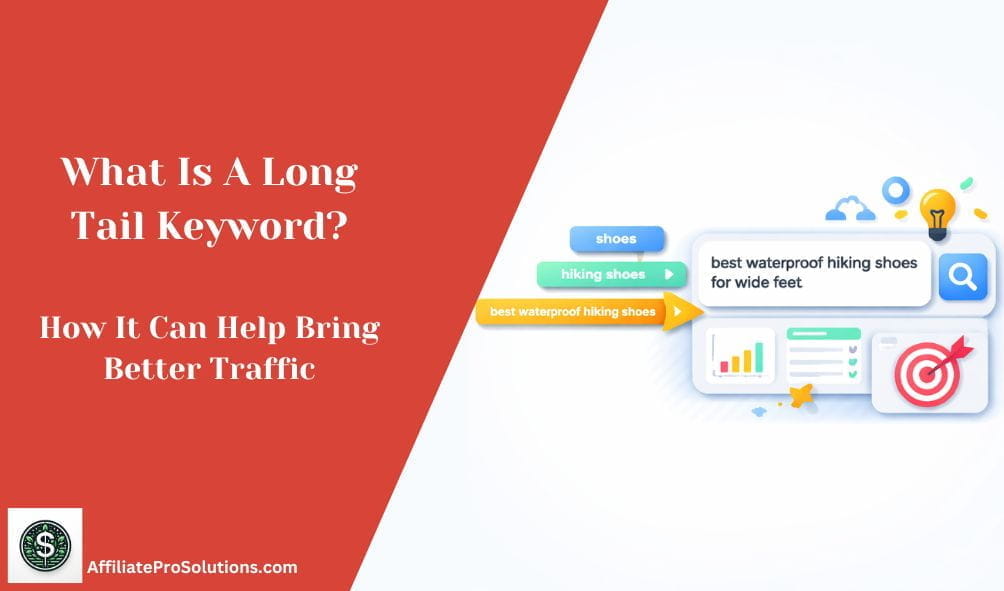
A long tail keyword is a specific search phrase that has a clearer search intent. It usually targets a narrower need than a broad keyword, which means the person searching already has a better idea of what they want. Instead of a wide search like “shoes,” a long tail keyword would be something like “best waterproof hiking shoes for wide feet.” That search is more detailed and gives a much clearer picture of the problem, need, or product being searched for.
A lot of people think long tail keywords are defined only by length, but that is not really true. Many of them do contain three words or more, but the word count on its own doesn’t decide it. What matters more is how specific the phrase is, how clear the intent is, and how broad or narrow the search results are. A short phrase can still be long tail if it points to one exact thing, while a longer phrase can still be too broad.
The term “long tail” comes from the way search demand is spread across broad and specific searches. A few broad keywords get very high search volume, while many more specific searches sit in the long tail with a lower individual volume, but have huge value when they are added together.
What You’ll Learn From This Post
- Long Tail Is Not Only About Word Count – Why a longer search phrase is not always long tail, and why specificity and intent matter more.
- Clear Search Intent Matters – How long tail keywords can bring in people who already know more clearly what they are looking for.
- Lower Volume Can Still Be Worthwhile – Why a keyword with fewer searches can still bring more useful traffic.
- Where Long Tail Ideas Come From – Common places to find the exact phrases people are already searching for.
- How To Use Long Tail Keywords Properly – How to group, place, and use long tail keywords across your content without forcing them.
Summarize This Content Using AI

Start Your Training
- Build Your Website & Earn Revenue
- Support, Tools & Training Included
- Complete with Business HUB
- Artificial Intelligence Writers
- My Personal Support
- No Risk Free Starter Account
- FREE BONUS AI CREDITS
TL;DR
What Is A Long Tail Keyword?
A long tail keyword is a more specific search phrase that usually shows clearer intent as opposed to a broad keyword. It can help you bring in better traffic because the person searching often already knows more about what they want. This post explains what long tail keywords are, clears up the idea that they are only about word count, and shows why search intent matters more. It also goes into how these keywords can help with topic coverage, lower competition, and content planning when you want visitors who are more likely to connect with what your page is actually about.
What Long Tail Keywords Tell You About A Search
When someone searches for a broad keyword such as “headphones,” the search can go in a lot of different directions. Google may show shopping pages, reviews, brand pages, news, videos, and local results all at once. That usually happens because the search is still quite open, so the person searching might still be figuring out what they want.
A long tail keyword gives a much clearer picture. If someone searches for “best Bluetooth headphones with long battery life for travel,” the search is far more specific. It shows a clear need, and that makes it easier for the right page to appear in front of the right person.
This is one of the main reasons long tail keywords matter. They help bring in visitors whose search is already closer to the answer, product, or page they are looking for.
This is also where broad keywords and long tail keywords start to separate more clearly. A broad search can lead to mixed results because the intent is still open, while a long tail search usually points to a more exact need. That clearer intent is a big part of what makes long tail keywords so useful.
Different Types Of Long Tail Keywords
Long tail keywords are not just for buyer searches. They can show up in different ways depending on what the person wants help with.
Informational – “how to fix my bluetooth headphones that won’t charge”
Commercial or transactional – “cheapest 4k television for a small bedroom”
Local – “best sushi restaurant near me open late”
Problem solving – “laptop freezes when it’s connected to an external screen”
What these examples have in common is that each one points to a more specific need.
Low search volume can also be misleading. A keyword does not lose value just because fewer people search for it. In many cases, a smaller number of highly relevant visitors is far more useful than a larger number of vague ones.
Those visitors are often more likely to read the page properly, take action, join a list, or spend longer on the page.
How Long Tail Keywords Help Bring In The Right Traffic
Getting more clicks is not always the main goal. What matters more is whether the right people are landing on the page. Long tail keywords can help with that because they often bring in visitors whose search is already much closer to what the content is actually about.
More Focused Visits
When a page targets a long tail keyword, it is more likely to appear for someone with a clear question, problem, or goal. This is important because the page is then being shown to people who are already looking for that exact kind of information, product, or answer.
Better Visitor Quality
Pages built around specific searches can keep people on the page longer because the content is closer to what they were hoping to find. That can lead to more clicks, more sign-ups, more sales, or simply more useful visits, depending on what the page is there to do.
Lower Competition
Broad keywords are often busy and harder to rank for, especially on newer websites or smaller sites. Long tail keywords are usually more realistic because fewer pages are targeting the exact same search in the same way.
Traffic That Adds Up
One long tail keyword may only bring in a small number of visits, but that doesn’t mean it has no value. When many specific pages start ranking for many specific searches, the traffic builds up across the site.
Better Topic Coverage
Covering related long tail keywords across a topic can also help build stronger coverage of that subject. When a website answers a wide range of specific questions clearly, it gives the search engines and readers more reason to see that site as useful on the subject overall.
How To Group And Target Long Tail Keywords
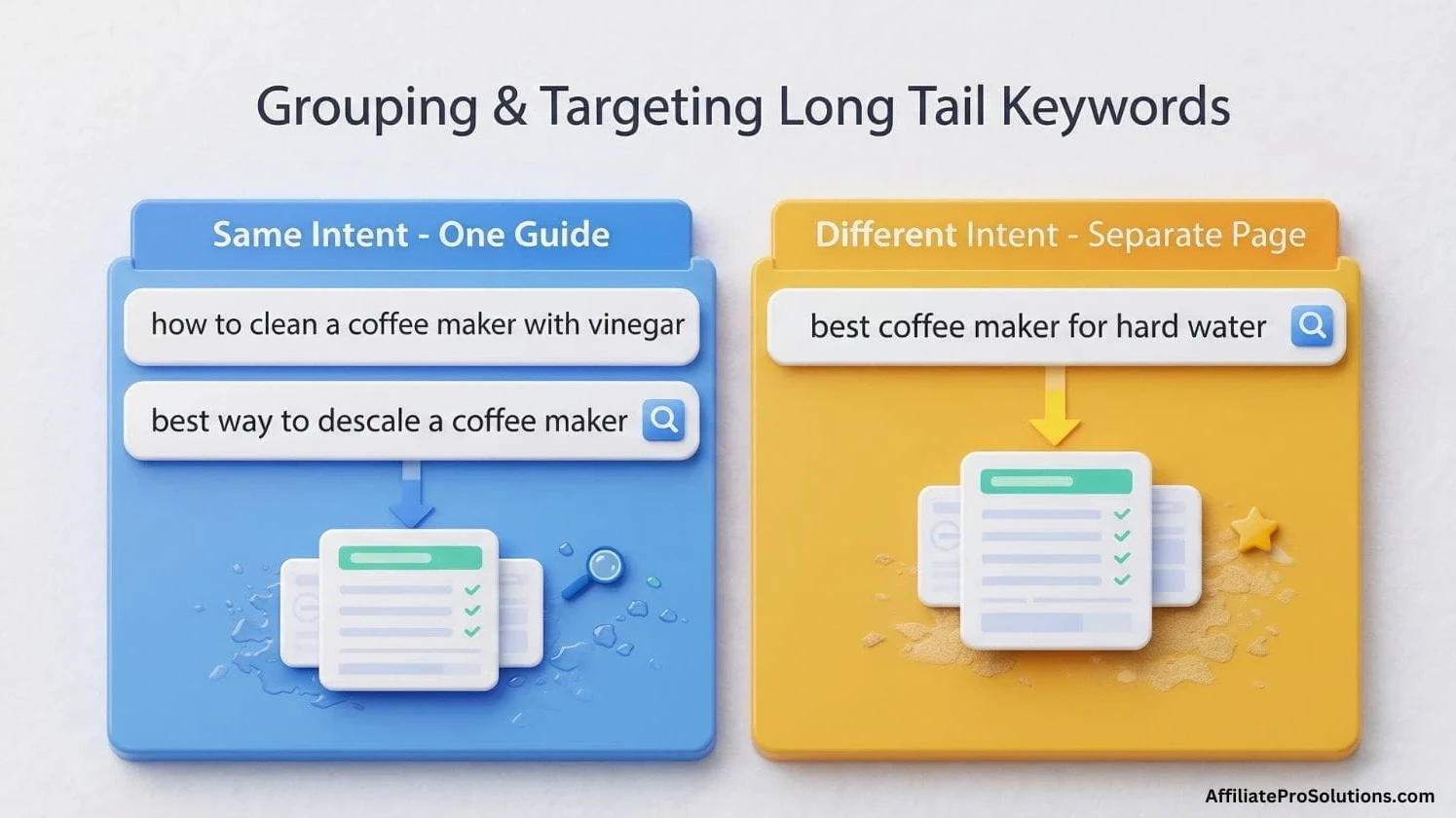
A common mistake is thinking every long tail keyword needs its own page. In most cases, that just creates too many small pages covering almost the same thing. A better way to do it is to group keywords by shared intent and decide what the searcher is trying to do.
For example, a search like “how to clean a coffee maker with vinegar” and “best way to descale a coffee maker” could usually be covered in one strong guide, because the search intent is very close. But a search like “best coffee maker for hard water” is asking for something different, so that would likely need its own page.
This also helps to keep the website organised. A broad page can cover the wider topic, while more specific pages can deal with narrower questions that need more detail. Internal links then help connect those pages, making it easier for both readers and search engines to move through the topic.
Checking the search results can help you decide which type of page is the better choice, because Google often shows whether people expect a full page on that topic or just a section inside a broader guide.
Quick Tips For Organizing Long Tail Content
Broad pages – Use these for wider topics that answer several related questions.
Narrow pages – Use these for specific problems, local searches, or focused comparisons.
Internal links – Link related pages together so the topic stays connected and is easier to follow.
Where To Find Long Tail Keyword Ideas
This is one of the most useful parts of keyword research, because long tail ideas can come from all sorts of places. The main thing here is not to rely only on keyword tools. A lot of the best phrases come from the way real people talk, search, and ask questions.
Some of the best places to look are these.
- Google Autocomplete – Start typing your main keyword into Google and look at the suggestions that appear. These can show common searches and natural phrasing.
- People Also Ask – This section often shows related questions that can lead to strong long tail ideas.
- Related Searches – Scroll to the bottom of the search results and you will often see extra phrases people are using.
- Google Search Console – This can show searches that are already bringing people to your website, including ones you may not have noticed before.
- Competitor research – Tools such as Ahrefs, Semrush, or Ubersuggest can help show which long tail keywords similar websites are already ranking for.
- Forums and discussion sites – Places like Quora and Reddit are full of questions written in everyday language.
- Website search data – If your website has a search bar, look at what visitors type into it.
- Reviews and comments – People often describe problems, features, and needs in their own words, and that can lead to keyword ideas you would not get from a keyword tool.
- Social platforms – Facebook groups, TikTok comments, X posts, and other social platforms can reveal the wording people actually use.
It is also worth paying attention to the language people use. Most searchers are not typing like SEO professionals. They are using plain words, direct questions, local phrases, and sometimes even spelling mistakes. That is the kind of wording that can lead to useful long tail keyword ideas because it reflects how people actually search.
Long Tail Modifiers That Help
One of the easiest ways to build long tail keywords from a broader phrase is to add modifiers. These help narrow the search and show clearer intent.
Some common ones are these.
- Audience – for teachers, for toddlers, for seniors, for contractors
- Location – near me, in Chicago, UK only
- Price – cheap, under $20, premium
- Use case – for small spaces, for beginners, for home office
- Urgency – last minute, open now
- Feature – waterproof, wireless, foldable
- Problem – won’t turn on, leaking, missing button
- Timing – this year, best in summer, for winter
These can also be combined. For example, “best budget wireless headphones for kids this year” is much more specific than just “wireless headphones.” Searches like that often show clearer intent and give you a better idea of what the person actually wants.
Additional Keyword Research Info & Resources
How To Use Long Tail Keywords Naturally
Long tail keywords should be used so they come across as natural on the page and repeating the same phrase too many times doesn’t help. Search engines are much better now at understanding meaning, so the idea is to use the keyword where it belongs and keep the writing clear.
A good place to start is with the main areas of the page.
- Put the main keyword, or a close variation, in the page title, the opening heading, and the introduction if it reads naturally.
- Use related phrases in subheadings, body text, lists, tables, and FAQs where they help.
- Add them to product descriptions or feature lists if the page is about a product.
- Use them in internal links when linking to related pages on the same website.
Your main focus should always be the search itself. A page should answer the question, problem, or need behind the keyword, rather than just repeating the wording. Google also recommends focusing on helpful, people-first content instead of writing mainly for search engines. It also helps to give the answer early and keep the layout clear so the page is easy to follow.
If the intent is not obvious, check the search results. If Google is showing ranking guides, comparison pages, or product pages, that usually gives a strong clue about the kind of page people expect to see.
Quick Formatting Ideas That Help
- Put a direct answer near the top of the page.
- Use clear subheadings written in normal language.
- Keep paragraphs fairly short so the page is easier to read.
- Add FAQ sections only when real questions need answering.
- Use tables or comparison lists when they help explain products, features, or differences.
How Long Tail Keywords Can Help In PPC
Long tail keywords can also be useful in PPC campaigns (Pay Per Click) such as Google Ads. Because these searches are more specific, the ads can be more closely tied to what the person is looking for. That can help improve relevance and may help reduce the cost per click.
The traffic may be lower than it would be with broader keywords, but the search is often more focused. That means the people clicking the ad may be closer to taking action, especially when the keyword shows a clear need, problem, or buying intent.
This can be especially useful for local services, niche products, and campaigns where wasted clicks are a concern. Instead of paying for broad traffic that may not go anywhere, long tail keywords can help bring in people who are searching in a more specific way.
The Most Common Mistakes With Long Tail Keywords
These points have already come up earlier in the post, but it helps to bring the main mistakes together in one quick list.
- Judging them only by the word count.
- Going after low-competition keywords with no clear value.
- Making a separate page for every small variation.
- Forcing exact phrases into the writing.
- Assuming every long tail keyword leads straight to sales.

Frequently Asked Questions – FAQs
A long tail keyword is a specific search phrase that shows clearer intent than a broad keyword. It usually targets a narrower need, which can make it easier to create content that closely answers what the person is searching for. Long tail keywords are often less competitive than broad terms, although they are not defined only by the word count.
An example of a long tail keyword would be “best waterproof hiking shoes for wide feet.” This is more specific than a broad search like “shoes” because it points to a clearer need and gives a stronger idea about what kind of page the searcher wants to find.
No. Many long tail keywords do contain three or more words, but that is not what defines them on its own. A shorter phrase can still be long tail if it is specific enough, while a longer phrase can still be broad if the intent is not narrow enough.
Long tail keywords can be found through Google Autocomplete, Related Searches, People Also Ask, Google Search Console, keyword tools, and the language people use in forums, reviews, and comments. These sources help show the exact words people are using when they use Google.
Long tail keywords work best when they are used naturally in the page title, headings, introduction, subheadings, and other relevant parts of the content. The main aim is to answer the search clearly and fully, rather than repeat the exact phrase too many times. Google advises writing for visitors rather than cramming in keywords for the search engines.
If You’re Just Getting Started With Long Tail Keywords
If you are new to long tail keywords, the easiest way to start is to keep things simple.
- Start by checking what your website already ranks for in Google Search Console.
- Use Google Autocomplete and People Also Ask to find new ideas for posts or pages.
- Write one piece of content around a very specific question or need.
- Watch how it performs, then build on that with more related content.
- Use internal links to connect related pages as your coverage grows.
A lot of useful long tail keyword ideas are already out there in customer questions, review sections, comments, and the everyday language people use when they search.
What I’ve Learned From Working With Long Tail Keywords
I used to spend far too much time looking at big keyword search numbers and thinking they were the main thing to go after. On paper, they looked good and I thought I was in with a good chance to get rankings. In practice though, they often brought me frustration. The competition was harder, the search intent was broader, and even when I did manage to get some visibility, the traffic was not always as useful as I hoped it would be.
I then spent time improving my keyword research, and once I started paying more attention to specific searches and the kind of help people were actually looking for, things got better. Some of the keywords I started to use had a much lower search volume, but they gave me a better chance of creating pages that answered something clearly and properly. As time went on, that gave me a much better feel for what was worth targeting and what was only wasting my time.
That’s why I put a lot of value on long tail keywords now. They are not the only thing I look at, but they have helped me build content around real searches instead of going after big numbers just for the sake of it.
Final Thoughts
Long tail keywords help you target searches with clearer intent. They can also help you build stronger topic coverage and bring in visitors who are closer to what your page actually offers. That is one of the main reasons they are so useful, especially when broad keywords feel too competitive or too vague.
What has helped me most is stopping looking at big search numbers and paying more attention to what people are really trying to find. Once you start doing that, it becomes much easier to plan content that is clear, useful, and worth ranking.
Thanks for reading this post on What Is A Long Tail Keyword. If you have any questions, or if you have found your own way of finding long tail keywords, feel free to leave a comment below.
Chris
Wealthy Affiliate
This is where my journey into the online world began, and it’s still the community I use for learning, tools, and support while working on my own projects.

About Chris Towers – Follow Me

My name is Chris Towers, and I run Affiliate Pro Solutions. I work with websites, content, and affiliate projects, and this website is where I share what I’ve learned from doing that work.
Most of what I write about comes from researching hosting companies, tools, and platforms that people use when building websites or trying to earn online. I look at how things are set up, what’s included, and where people often get caught out later.
I’m not connected to the companies I review beyond standard affiliate partnerships. This site does include affiliate links, but the aim here is to explain how the services work rather than push anyone into a decision.
You’ll find me on
Related
- What Is A Long Tail Keyword? How It Can Bring Better Traffic To Your Site

- How To Know If A Keyword Is Worth Targeting Before You Create Content
- Effective Ways To Brainstorm Keywords That People Actually Search For
- How To Use Keywords In A Blog Post For The Best Results
- How To Search For Low Competition Keywords Easily
- How to Find Keywords for a Website and Get Seen Online





Just to be open with you, this page includes affiliate links. If you click on one of these links and make a purchase, I earn a small commission. There is no extra cost to you at all. This simply helps support the content I share here. Thank you for your support, it really is appreciated.
I always thought that long tail keywords just meant longer phrases, so this was good to know. The part about search intent and grouping similar keywords into one page was also new to me.
It’s easy to get carried away and make too many separate posts when the searches are really asking for the same thing.
Kiersti
Thanks Kiersti, I’m glad it helped.
I think a lot of people start off thinking it just means longer phrases, so you’re definitely not the only one. The search intent side of it is what really changed the way I look at keyword targeting as well.
Appreciate you reading.
Chris